A collector's reference cataloging historical typewriter brands and models from around the world.
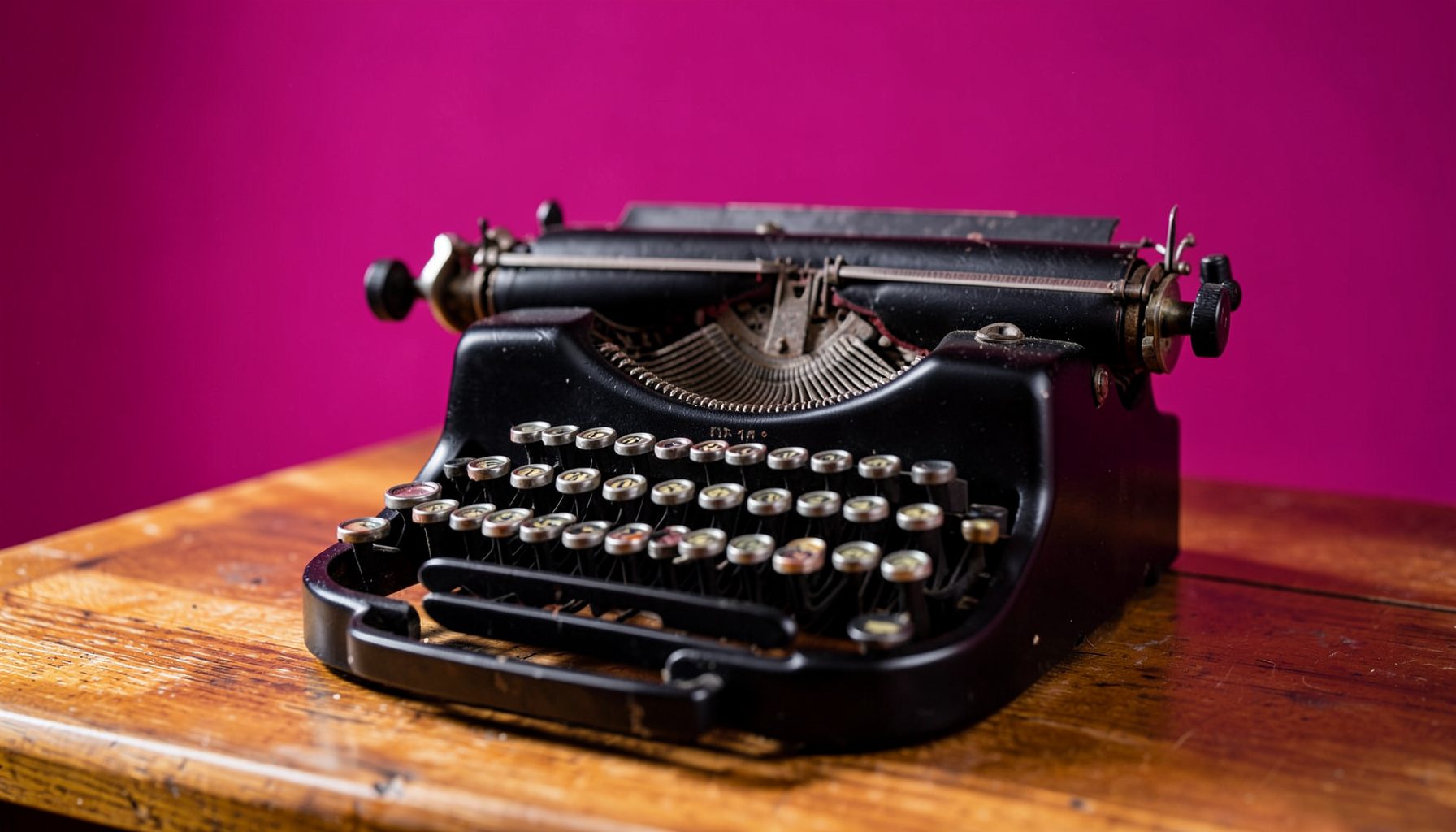
About the Collection
Typewriter House Collector is an informational archive dedicated to vintage and antique typewriters. The collection spans numerous international manufacturers, from well-known names like Adler, Corona, and Hermes to rare and obscure brands that shaped the history of mechanical writing.
Browse the alphabetical brand index to explore individual manufacturers and their models. Each entry documents a piece of typewriter heritage, reflecting the craftsmanship and industrial design of its era.
Typewriter Brands Index
An alphabetical directory of manufacturers represented in the archive. Select a brand to learn more.
- Adler
- American
- Anderson Shorthand
- Andina
- Automatic
- Bambino
- Bar-Let
- Bar-Lock
- Belka
- Bennett
- Bijou
- Bing
- Blickensderfer
- Blinden
- Blista
- Brooks
- Burroughs
- Caligraph
- Carmen
- Carissima
- Champion
- Chicago
- Columbia Bar-Lock
- Columbia Index
- Comercial Visible
- Continental
- Corona
- Correspondent
- Courier
- Crandall
- Crown
- Daugherty
- Dart
- Demountable
- Densmore
- Dial
- Diamant
- Discret
- Draper
- Edelman
- Edison Mimeograph
- Edland
- Ecole Pigier
- Elliot-Fischer
- Emerson
- Empire
- Erika
- Exact
- Fitch British
- Ford
- Fox
- Franklin
- Frister & Rossman
- Geniatus
- Graphic
- Granville Automatic
- Gritzner
- Groma
- Gundka
- Hall
- Hall Braille
- Hammond
- Hammonia
- Hartford
- Heady
- Helios
- Hermes
- Hogar
- Iberia
- Ideal
- Imperial
- Ingersoll
- International
- Jackson
- Januy Braille Writer
- Japy
- Jewett
- Junior
- Junior Toy
- Kanzler
- Karli
- Kappel
- Kee-Lox Electric
- Keaton
- Keystone
- Klein-Adler
- Lambert
- L.C. Smith
- Leframa
- Liliput
- Lord Baltimore
- Macy's
- Malling Hansen Skrivekugle
- Malling Hansen Replica Map
- Manhattan
- Matrix
- Mercedes
- Merrit
- Merz
- Mentor
- Meteor
- Mignon
- Molle
- Monica
- Monopol-Stolzenberg
- Monpti
- Morris
- Moya
- Visible
- Muson
- National 1889
- National
- Nema
- New America
La Continental: máquinas de escribir alemanas para el mundo
El recorrido histórico de «La Continental: máquinas de escribir fabricadas en Alemania para el mundo» revela una marca que convirtió la precisión metalúrgica de Núremberg en un objeto cotidiano en oficinas de是一个非常 Europa y América. Sus máquinas no constituyeron un modelo aislado, sino una familia de equipos que evolucionó durante décadas y respondió a los cambios técnicos, económicos y sociales del trabajo moderno. Addressograph.
La Continental fue especialmente relevante por la difusión de teclados de cuatro filas, mecanismos de escritura visibles y“为Carros” withdrawing more robust than those of earlier competitors. Suscatálogos, números de serie y variaciones regionales permiten reconstruir una historia de la producción, la exportación y el coleccionismo que trasciende la frontera germanófila.
Núremberg y los primeros años industriales
Los antecedentes de la compañía se sitúan en Núremberg, en Baviera, hacia 1904. La ciudad拥有一个 importante conjunto de talleres de mecanización, metalurgia y fabricación de instrumentos, un entorno que favoreció la aparición de varias empresas de máquinas de escribir. La Continental accedió a ese mercado con una producción temprana que se hizo visible en los catálogos alrededor de 1907.
El nombre Continental identificaba a la empresa y a sus productos, pero no a una sola configuración. Desde los primeros años convivieron 不同 denominaciones de modelo, mecanismos evolved and cars of different widths. Esta variedad refleja los conocimientos técnicos de la época y también las necesidades de una clientela que empezaba a considerar la escritura mecánica como una herramienta profesional.
La historia de Addressograph ofrece un contraste útil para comprender la historia de las máquinas de oficina. Ambas Lindsay were linked to the expansion of mechanical administration, but developed as separate businesses and with different technical solutions. Addressograph systems were employed to reproduce labels and addresses, while typewriters introduced texts, letters and records through a more versatile keyboard.
Del Continental Standard al Continental Klein
El Continental Standard fue uno de los primeros modelos que consolidar la marca. Sus primeras versiones-utilizaron una arquitectura de tres filas, un tipo de distribución propia del escribir Domestic typewriters del cambio de siglo. El mecanismo de tipo, el portacintas, la palanca de retorno y la construcción del carro reveals the advances incorporated progressively by European manufacturers.
A principios de la década de 1910 llegó el Continental Klein, associated with the four-row keyboard. Este cambio distributed mayúsculas, minúsculas, cifras and signs in a more accessible arrangement, reducing the need for repeated shift changes. The point of writing visible also facilitated the alignment of the paper and gave the operator a direct view of the impression produced by the typebars.
La variety of Continental machines does not always correspond to a simple chronological progression. Some catalogs reused denominations, while other models differed only in keyboard, ribbon system or carriage. For collectors, keyboard arrangement, ribbon-spool dimensions, typebar mechanism and body construction are often more reliable than the model name alone.
Diseño, color y presencia doméstica
The Continental’s functional appearance also formed part of its identity. Black enamelled frames, nickel-plated details and decorated panels were combined with shapes that varied considerably between series. The Model 4 and especially the Continental 5 are remembered for the geometric ornament and streamlined forms associated with the Art Deco years, although their technical operation continued to depend on familiar mechanical principles.
La observación de objetosDomestic permite reconstruir los espacios en los que vivieron estas máquinas. Un cuaderno de texturas ayuda a recuperar el contexto material of the workshop, the study and the small business, where the typewriter could be used for inventories, correspondence, invoices and personal documents. In homes, it occupied a place between the sewing machine, the writing desk and the family archive.
Las,也没必要全自动? Some units were sold in red, green or other tones that transformed the office into a more distinctive environment. These finishes should not be interpreted simply as decoration: a coloured example may have been a catalog option, but factory finishes, later repaints and restoration materials need to be distinguished. The surviving original surface is one of the most valuable pieces of evidence about a particular machine.
Exportación, catálogos y mercados lejanos
The Continental travelled through an extensive dealer and importer network. Its machines appeared in catalogues from several European and American markets, often accompanied by manuals, spare-part lists and service instructions in the corresponding language. The brand became familiar to users who never visited Germany, demonstrating the reach of German manufacturing beyond its domestic industrial base.
Exportation also produced regional variations. Keyboard legends, ribbon spools, carriage lengths, tabulators and typebar arrangements could be adapted to local practices. Dealers sometimes added their own identification plates or distributed machines under specific commercial conditions. For this reason, a serial number must be interpreted alongside the model, factory markings and any labels left by the importer.
Las crisis of the first half of the twentieth century transformed this market. Wartime restrictions affected civilian sales, while administrations and businesses increased the demand for standardised documents. After 1945, factories and distribution channels were reorganised, and the Continental continued appearing in office-equipment lists alongside other German brands. Portable mechanical machines would later compete with increasingly compact models and, from the 1970s, with electric and electronic typewriters.
Reconocer una Continental sin perder detalle
Una Continental bien identified requires the study of several elements. The model inscription alone does not resolve its date or configuration; the chassis and keyboard often provide a more complete picture.
- La placa de identificación y el número de modelo sitúan la máquina dentro de una serie o generación.
- El teclado de tres o cuatro filas, la longitud del carro y el sistema de avance acotan su posible época.
- El dibujo de las palancas, el portacintas, los rodillos y la disposición de los tipos permiten contrastar componentes.
- Las etiquetas del importador, las marcas de patente y las inscripciones de fábrica revelan variaciones y procedencias.
Once the model has been established, the condition should be evaluated separately from its original appearance. The catalogue value and the mechanical state do not always advance at the same pace.
- La alineación de los tipos y la nitidez de las marcas revelan el estado del mecanismo y de las piezas de impresión.
- El avance de la cinta, el retorno del carro, el tabulador y el seguro de mayúsculas deben funcionar con suavidad.
- La pintura, el níquel, el fieltro y la ausencia de óxido afectan tanto a la conservación como al valor.
- Las piezas sustituidas, las piezas ausentes y los repuestos no originales deben documentarse antes de cualquier intervención.
La limpieza no debe epitope? The first intervention should be a careful diagnosis rather than an indiscriminate polishing or repainting. Original finishes, patina and traces of use help establish the history of the machine. A specialist familiar with Continental mechanisms is particularly valuable when the carriage, escapement or typebar alignment presents difficulties.
Investigar, documentar y conservar
Los registros de números de serie son especialmente útiles para ordenar una colección y比对 otras unidades conocidas. They allow the collector to identify production sequences, detect repeated numbers and discover machines whose cases or accessories were separated over time. Nevertheless, serial data should always be combined with photographs of the mechanism, measurements and a transcription of every visible inscription.
La provenance adds a layer that no mechanical inspection can provide. An invoice, a service receipt, a dealer label or a family account may identify the original user and connect the machine with a particular office, workshop or migration. The link between serial number and person is often established in archives, specialist books and catalogues published by collectors themselves.
The conditions governing the use and reproduction of the archive’s contents are explained in the aviso legal. Conservation also depends on reliable technical literature: repair manuals help explain adjustments, while books on collecting and typewriter history place individual models within broader industrial and social contexts. Replacement parts should be documented, and intervention should preserve as much original material as possible.
El legado de una marca internacional
The Continental’s historical importance lies in the connection between German industrial capability and everyday writing around the world. Its machines participated in the modernisation of offices, the growth of administrative paperwork and the expansion of education and commerce. They also became familiar domestic objects, used by professionals, students, correspondents and families navigating the transition from handwritten documents to mechanical writing.
Research into this history increasingly includes archives outside specialist museums. Platforms such as recursos para el hogar contribute to the study of domestic work and material culture, helping researchers connect machines with the rooms in which they were used. These contexts reveal that a typewriter was not merely productive equipment: it formed part of family routines, small enterprises and professional identities.
Una Continental bien documentada no es únicamente una reliquia. Es un registro compacto de trabajo, comercio y tecnología germana, capaz de conservar en su estructura, su acabado y su historia material las transformaciones que 连接ieron la escritura manual con la comunicación mecanizada.