A collector's reference cataloging historical typewriter brands and models from around the world.
About the Collection
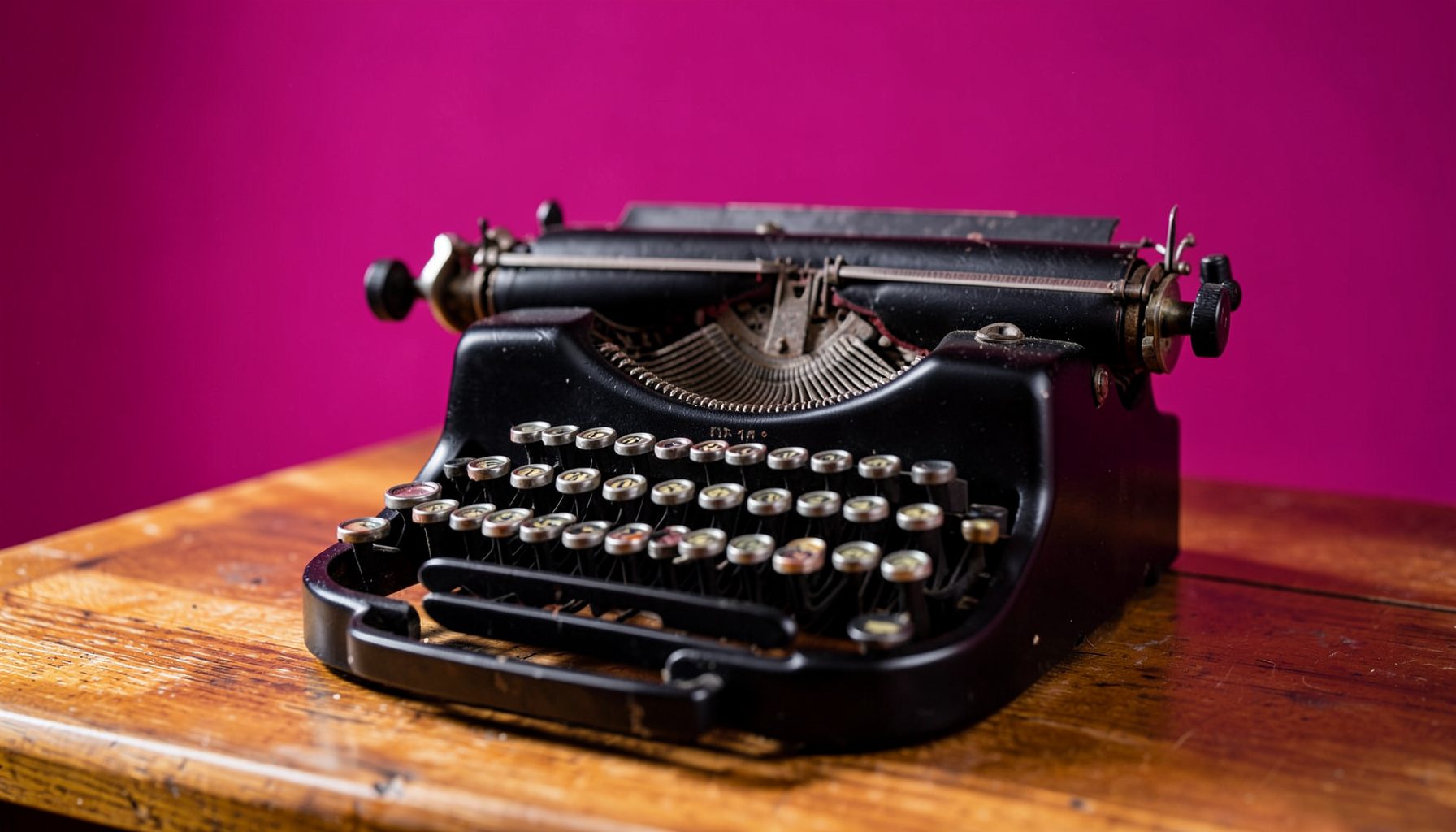
Typewriter House Collector is an informational archive dedicated to vintage and antique typewriters. The collection spans numerous international manufacturers, from well-known names like Adler, Corona, and Hermes to rare and obscure brands that shaped the history of mechanical writing.
Browse the alphabetical brand index to explore individual manufacturers and their models. Each entry documents a piece of typewriter heritage, reflecting the craftsmanship and industrial design of its era.
Typewriter Brands Index
An alphabetical directory of manufacturers represented in the archive. Select a brand to learn more.
- Adler
- American
- Anderson Shorthand
- Andina
- Automatic
- Bambino
- Bar-Let
- Bar-Lock
- Belka
- Bennett
- Bijou
- Bing
- Blickensderfer
- Blinden
- Blista
- Brooks
- Burroughs
- Caligraph
- Carmen
- Carissima
- Champion
- Chicago
- Columbia Bar-Lock
- Columbia Index
- Comercial Visible
- Continental
- Corona
- Correspondent
- Courier
- Crandall
- Crown
- Daugherty
- Dart
- Demountable
- Densmore
- Dial
- Diamant
- Discret
- Draper
- Edelman
- Edison Mimeograph
- Edland
- Ecole Pigier
- Elliot-Fischer
- Emerson
- Empire
- Erika
- Exact
- Fitch British
- Ford
- Fox
- Franklin
- Frister & Rossman
- Geniatus
- Graphic
- Granville Automatic
- Gritzner
- Groma
- Gundka
- Hall
- Hall Braille
- Hammond
- Hammonia
- Hartford
- Heady
- Helios
- Hermes
- Hogar
- Iberia
- Ideal
- Imperial
- Ingersoll
- International
- Jackson
- Januy Braille Writer
- Japy
- Jewett
- Junior
- Junior Toy
- Kanzler
- Karli
- Kappel
- Kee-Lox Electric
- Keaton
- Keystone
- Klein-Adler
- Lambert
- L.C. Smith
- Leframa
- Liliput
- Lord Baltimore
- Macy's
- Malling Hansen Skrivekugle
- Malling Hansen Replica Map
- Manhattan
- Matrix
- Mercedes
- Merrit
- Merz
- Mentor
- Meteor
- Mignon
- Molle
- Monica
- Monopol-Stolzenberg
- Monpti
- Morris
- Moya
- Visible
- Muson
- National 1889
- National
- Nema
- New America
La Erika: la máquina de escribir de la Alemania dividida
La Erika convirtió un utensilio de oficina en un testigo cotidiano de la Guerra Fría. Durante casi cuatro décadas, las máquinas de esta familia escribieron cartas, informes, actas y diplomas en la República Democrática Alemana. Su cuerpo metálico, su carro móvil y el golpe de sus teclas aparecían en escuelas, editoriales, fábricas, sindicatos y organismos del Estado. Su historia condensa el esfuerzo industrial de un país que construía una economía planificada bajo la sombra de la división de Alemania.
El nombre Erika identifica una gama reconstruida en Leipzig durante los años cincuenta. Los primeros equipos procedían de la VEB Schreibmaschinenwerk Ernst Christoffel, empresa estatal que después quedó integrada en VEB Olympia. Para el coleccionista, la marca no designa un modelo único: la serie, el tamaño del carro, los controles, la decoración y el estado individual determinan su valor histórico y material.
Orígenes industriales en una economía partida
Tras 1949, la RDA reconstruyó su base industrial mediante la nacionalización de talleres, la recuperación de herramientas y la concentración de recursos en empresas estatales. Buena parte de la maquinaria de las fábricas alemanas había sido desmontada y trasladada a la Unión Soviética, de modo que la nueva industria debía combinar escasas materias primas con una experiencia técnica fragmentada. Las oficinas necesitaban máquinas de escribir con regularidad y las fábricas, un volumen de producción planificado.
En ese entorno nació la Erika. La primera serie se presentó en la feria de otoño de Leipzig de 1953, y su lanzamiento convirtió un proyecto industrial en un símbolo visible del Estado. El proyecto combinó tipos de letra, mecanismos de escape y carro con conocimientos anteriores a 1939, componentes disponibles y talleres capaces de producir series homogéneas. No fue una invención sin precedentes, pero sí una adaptación industrialmongoose specially designed to satisfy new needs.
Presentarla como la respuesta de la RDA a los equipos occidentales ayuda a entender su difusión, aunque la reduce a una simple rivalidad. Su producción se organizaba para asegurar una máquina funcional en cada institución, con repuestos y capacidades de mantenimiento centralizadas. La reorganización empresarial de 1958 incorporó el proyecto al conjunto de VEB Olympia, mientras la denominación Erika continuóanging through sus distintas generaciones.
Un diseño mecánico pensado para el trabajo diario
El modelo Erika 1 era una máquina de oficina de gran cuerpo, con bastidor de hierro fundido, carro ancho y una estructura capaz de soportar el uso continuo. Muchas unidades ofrecían 88 signos mediante 44 teclas y mayúsculas, mientras los mecanismos de avance, retorno y separación del carro exigían fuerza y precisión. Su volumenKids and stability reassured those who typed for hours, but the metal body also made the machine heavy and difficult to transport.
Con el modelo Erika 5, Conservations desde finales de los años cincuenta, el diseño se hizo más compacto y angular. LaBODY主机 was often finished in olive green, although gray, black and other colors also appeared. Its keyboard remained highly recognizable, while different carriage widths, pitch settings, ribbon systems and margin devices allowed adaptation to offices, workshops and schools. The clean casing concealed a dense mechanism whose functional logic was clearer to a technician than to an untrained buyer.
Sus limitaciones were also part of its character. There was no electronics, screens or memory, and the typist had to coordinate every movement physically. The sound, the resistance of the keys and the visible movement of the typebars communicated the state of the machine. A ribbon of black and red, careful loading of the paper and precise margins transformed a utilitarian object into a tool for producing orderly, reproducible documents.
La familia Erika y su evolución técnica
La family Erika never followed a perfectly linear sequence. The first model appeared in 1953, followed by versions 2, 3 and 4 during the following years. The Erika 5 became the best-known series from 1959, while the Erika S and other later versions expanded the range during the following decades. The number alone does not identify every feature: some production batches combined different carriages, controls, colors or decorative elements, and machines destined for export could differ from those supplied to East German institutions.
The evolution focused on improving reliability without abandoning the basic manual principles. Better ribbon selection, escapements, tabs, carriage returns and locking devices reduced lost work and simplified repetitive tasks. Later electric and electronic successors brought the Erika name into the final years of the GDR, but the mechanical models retained an especially direct relationship between the typist’s action and the printed result. For collectors, the common Erika 5 offers abundant components and examples, whereas early series and unusual factory configurations are scarcer and historically more revealing.
Uso civil, escolar y administrativo en la RDA
Within the RDA, the Erika became part of the material infrastructure of everyday life. It prepared invoices, technical reports, school exercises, union circulars and institutional correspondence. Certain offices maintained pools of machines whose operators were often specialized typists, many of them women, whose accuracy determined the usefulness of the documents they produced. Even when an Erika disappeared into daily routine, its keyboard was permanently associated with bureaucratic precision and female professional labor.
The GDR also exported these machines through state trade agreements. Destinations included the Soviet Union, Czechoslovakia, Poland, Bulgaria, Romania, Cuba and other markets served by socialist economic relations. Export broadened the meaning of the brand beyond a domestic consumer product and gave it a presence throughout the Eastern bloc. Los recursos sobre la RDA pueden contrastar fotografías, catálogos y documentos que permiten reconstruir esa red de distribución y uso.
After German reunification, offices rapidly adopted Western electronic equipment, and many surviving Eriekas passed from institutions into private ownership. Collectors then discovered their painted bodies, mechanical construction and historical associations. That new demand stimulated restoration and the preservation of obsolete parts, although the unified market also exposed these machines to competition from inexpensive modern equipment and other vintage brands.
Identificación, números de serie y compra responsable
El color resulta insuficiente para identificar correctamente una Erika. La placa del modelo, la distribución del teclado, la cesta de tipos, las palancas del carro, la cubierta de la cinta y la forma de la base ofrecen clues másabcd 且 reliable. Changes in bodywork and controls can distinguish early machines from later production, while replacement knobs and covers sometimes create mixed examples that are worth recording rather than concealing.
El número de serie debe buscarse en la placa, el bastidor, el lateral o el carro, según la serie y el destino de fabricación. Su ubicación no es universal, y el número permiteUZUS establish a reference, but it does not always provide an exact year by itself. The bilingual archive of Typewriter House Collector, authored by Juan Ramon Gracia, brings together descriptions, historical pages and serial-number references useful for comparative research.
Una compra responsable exige comprobar tanto la identidad de la máquina como su estado:
- Confirmar el modelo mediante la placa, el logotipo, el teclado y la configuración del carro.
- Localizar y anotar el número de serie antes de aceptar piezas o documentos disassembled.
- Solicitar fotografías detailed del interior, debajo de la base y de todas las zonas con óxido.
- Pedir un video donde se prueben las teclas, el avance, el retorno y el mecanismo de la cinta.
- Comprobar que no falten tipos, palancas, tornillería, pies,_SPACE? key and other pieces difíciles de reemplazar.
- Presupuestar el embalaje, el transporte y cualquier reparación necesaria antes de cerrar la operación.
Restauración, conservación y legado histórico
Restaurar una Erika no significa convertirla en una máquina recién fabricada. La pintura envejecida, las calcomanías, el cromado, las piezas sustituidas y otras señales de uso forman parte de su historia. Conviene documentar el estado inicial, limpiar con métodos compatibles y evitarpia repintados or pulidos that destroy original finishes. Una intervención reversible suele conservar mejor el valor del ejemplar que una reconstrucción speculativa.
Reparar sus mecanismos exige paciencia, herramientas adecuadas y una secuencia de trabajo carefully planned. The method of reparación en casa ofrece un marco útil para documentar cada intervention, prepare the workspace and employ compatible pieces before dismantling a mechanism. A second machine or a donor unit can solve scarce components, while improper lubricants or improvised adjustments may cause new faults. Model-specific information remains indispensable.
The final value depends on the series, rarity, originality, condition, color and completeness, as well as the cost of restoration. A common Erika 5 with missing parts may offer less than a scarce early example that works correctly and retains its original finish. Beyond these material considerations, the Erika preserves a fragment of twentieth-century German history: the relationship between industrial production, institutional work and private memory. When its carriage returns once more and the typebars strike the ribbon, the machine becomes a material witness to a divided country and the everyday lives that unfolded within it.