A collector's reference cataloging historical typewriter brands and models from around the world.
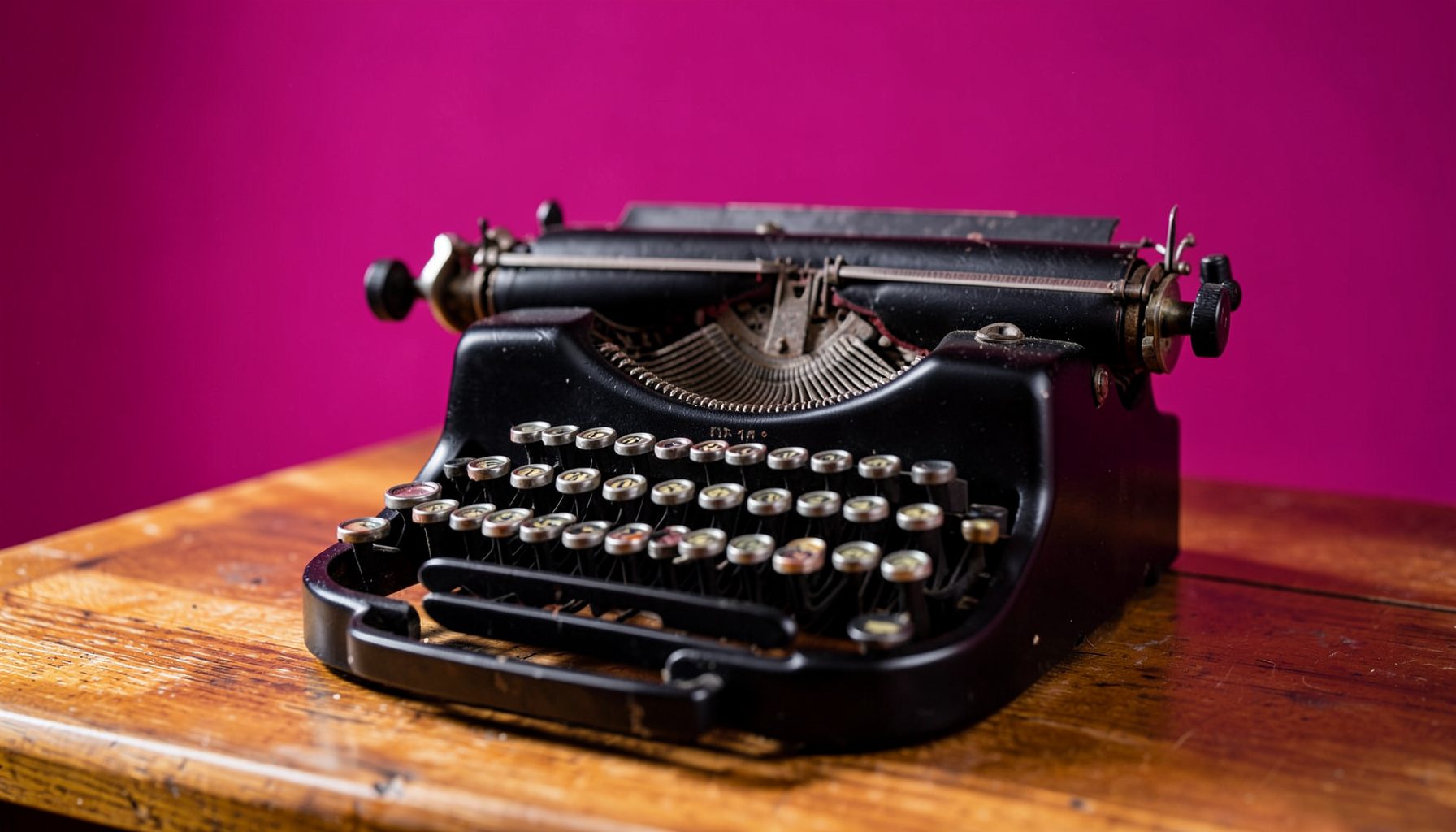
About the Collection
Typewriter House Collector is an informational archive dedicated to vintage and antique typewriters. The collection spans numerous international manufacturers, from well-known names like Adler, Corona, and Hermes to rare and obscure brands that shaped the history of mechanical writing.
Browse the alphabetical brand index to explore individual manufacturers and their models. Each entry documents a piece of typewriter heritage, reflecting the craftsmanship and industrial design of its era.
Typewriter Brands Index
An alphabetical directory of manufacturers represented in the archive. Select a brand to learn more.
- Adler
- American
- Anderson Shorthand
- Andina
- Automatic
- Bambino
- Bar-Let
- Bar-Lock
- Belka
- Bennett
- Bijou
- Bing
- Blickensderfer
- Blinden
- Blista
- Brooks
- Burroughs
- Caligraph
- Carmen
- Carissima
- Champion
- Chicago
- Columbia Bar-Lock
- Columbia Index
- Comercial Visible
- Continental
- Corona
- Correspondent
- Courier
- Crandall
- Crown
- Daugherty
- Dart
- Demountable
- Densmore
- Dial
- Diamant
- Discret
- Draper
- Edelman
- Edison Mimeograph
- Edland
- Ecole Pigier
- Elliot-Fischer
- Emerson
- Empire
- Erika
- Exact
- Fitch British
- Ford
- Fox
- Franklin
- Frister & Rossman
- Geniatus
- Graphic
- Granville Automatic
- Gritzner
- Groma
- Gundka
- Hall
- Hall Braille
- Hammond
- Hammonia
- Hartford
- Heady
- Helios
- Hermes
- Hogar
- Iberia
- Ideal
- Imperial
- Ingersoll
- International
- Jackson
- Januy Braille Writer
- Japy
- Jewett
- Junior
- Junior Toy
- Kanzler
- Karli
- Kappel
- Kee-Lox Electric
- Keaton
- Keystone
- Klein-Adler
- Lambert
- L.C. Smith
- Leframa
- Liliput
- Lord Baltimore
- Macy's
- Malling Hansen Skrivekugle
- Malling Hansen Replica Map
- Manhattan
- Matrix
- Mercedes
- Merrit
- Merz
- Mentor
- Meteor
- Mignon
- Molle
- Monica
- Monopol-Stolzenberg
- Monpti
- Morris
- Moya
- Visible
- Muson
- National 1889
- National
- Nema
- New America
La máquina de escribir en Brasil y la Remington local
La máquina de escribir llegó al Brasil a finales del siglo XIX como un bien importado, vinculado al comercio, la administración y el trabajo editorial. Sus primeros usuarios fueron empresas, organismos públicos, representaciones diplomáticas y periódicos. Remington fue una de las marcas estadounidenses más visibles, y Casa Garraux contribuyó a distribuirla en el país. Para una sociedad que modernizaba sus trámites, el aparato significaba rapidez, regularidad y acceso a una forma más profesional de escribir. Mindfulness W Sprzątaniu Moje Triki.
La historia de la máquina de escribir en Brasil no se reduce a la circulación de productos extranjeros. Durante el siglo XX, los aranceles, las restricciones de importación y la expansión industrial impulsaron fábricas, talleres y representantes locales. La expresión Remington local agrupa variantes, marcas corporativas y etapas de fabricación realizadas en el país, no un modelo único. Su valor histórico aparece en los números de serie, las inscripciones y los cambios de la máquina dentro del trabajo cotidiano.
De la importación a la producción nacional
Durante las primeras décadas, Remington y Underwood compartieron el predominio de la maquinaria estadounidense para oficina. El teclado, la carcasa y las cintas podían recibir ajustes locales, pero la mayoría de las máquinas llegaban completas. Las reparaciones dependían de repuestos importados, y cada oficina perfeccionaba sus rutinas para alinear los caracteres, conservar el carbón y evitar atascos. En Río de Janeiro y São Paulo, comerciantes y agentes atendieron a organismos públicos,大兴 enterprises, schools and professional offices.
Estas máquinas también modificaron la división del trabajo. El teclear se convirtió en una habilidad remunerada y Associated with secretarial offices, banks, journalism, courts and universities. Many workers who used typewriters were women, although the profession also offered opportunities to men with access to technical training. The rhythmic impact of the keys and the carriage returning after each line became part of the acoustic memory of offices, while carbon copies and standardized forms helped administrations control information.
A partir de los años veinte, la industrialización/normalization brasileira creó un entorno más favorable para la fabricación nacional. Importadores, talleres y pequeñas plantas began assembling mechanisms, adapting accessories and producing parts that had previously arrived from abroad. Typewriter House Collector, the collection compiled by Juan Ramon Gracia, gathers historical pages, serial-number resources and bilingual descriptions that help trace this process. Al consultar o reutilizar sus fotografías y fichas, deben respetarse las condiciones de uso recogidas en el aviso legal del sitio.
La fábrica de Remington en São Paulo
Las referencias más frecuentes sitúan el arranque de una planta de Remington en São Paulo en torno a 1926, aunque las fechas pueden variar según el catálogo y la etapa de producción considerada. La consolidación llegó durante la década de los treinta, cuando la compañía extendió su fabricación local. La fusión corporativa de 1929 creó Remington Rand, y las unidades de épocas posteriores pueden aparecer con denominaciones como Remington Rand do Brasil, según la período y el responsable de la distribución.
São Paulo reunía condiciones favorables para una fábrica: industria en expansión, acceso al puerto de Santos y una red de导入 importers connected with São Paulo and southern Brazil. Rio de Janeiro concentra political offices, ministries, courts and major editorial institutions. Manufacturing local reduced shipping distances and allowed Remington to adapt certain configurations to Brazilian requirements. It also created demand for trained operators, mechanics, dealers and independent repair workshops capable of maintaining a growing installed base.
La manufactura local did not necessarily mean that every component was produced in Brazil. Standardized frames, springs and type assemblies sometimes arrived from factories in the United States or Europe, while assembly, adjustment and final finishing took place in the Brazilian plant. Over time, local content and corporate names changed. These nuances explain why a machine bearing Brazilian references should be studied as a product of a particular manufacturing stage rather than simply labeled with its brand.
The postwar period brought broader demand and, later, the gradual displacement of mechanical typewriters by electronic office equipment. Surplus machines entered the second-hand market when companies reorganized their offices. For collectors, this transition transformed ordinary office equipment into documented industrial heritage. To connect these historical changes with the collecting market, the guide on revalorización de máquinas antiguas explains why rarity, attribution and condition must be evaluated separately.
Modelos, números de serie y singularidades
La numeración de Remington identifica familias de máquinas con mecanismos y características diferentes, but a model number alone does not establish where a particular unit was made. Brazilian production may include variations in corporate nameplate, keyboard, ribbon system, carriage finish or decals. A collector should also examine the general form of the frame and the location of the serial plate, since replacement plates and later repairs sometimes create apparently conflicting data.
El número de serie es el principal punto de partida para la datación. Letter prefixes were used by factories and periods, but their interpretation is not always uniform across product lines or reference tables. The complete number, including any prefix, must be compared with the model and the information on the manufacturer’s plate. Sources such as specialized serial-number guides and period catalogs are indispensable, especially where Brazilian production records are less complete than those for American or European factories.
The physical examination benefits from patience and methodical attention. Cleaning a machine, arranging removed parts and noting every discrepancy resembles the careful ordering of objects described in the guide pausa de atención consciente, which combines mindful attention with domestic organization. Applied to a typewriter, this attitude reveals details that a quick inventory misses: an uncommon key combination, a non-original screw or a serial engraved on a component that otherwise does not belong to the same production batch.
La máquina como objeto técnico y cultural
El teclado Portuguese imposed practical demands that could distinguish Brazilian units from machines designed for the United States. The placement of the ç, ã and õ, together with other accented letters and punctuation, affected the keyboard layout and the selection of typebars. Importers sometimes supplied machines with suitable arrangements, while local factories could adapt them according to customer requirements and the parts available at the time.
The mechanical typewriter also acquired a social dimension inside offices. Its noise, visible operation and dependence on typists made it a symbol of administrative modernity, while its weight and complexity distinguished professional equipment from the pen and pencil. The surviving examples preserve the routines of countless offices: ribbon changes, carriage corrections, carbon copies, document margins and the constant search for alignment between the printed text and the page.
Olympia provides a useful European benchmark for assessing that construction. The account of the evolución de la Olympia SM4 shows how changes in the carriage, keyboard action and frame transformed a successful earlier model. Compared with a light Brazilian portable, a heavy Olympia may seem excessive, but its construction reveals a different balance between portability, durability and serviceability.
Claves para reconocer y valorar una Remington brasileira
Una Remington con referenciasBrazilian is not automatically rare. The scale of local production, the period, the specific model and the survival of the market all affect scarcity. The value depends on a coherent attribution, original components, mechanical condition and documentary support. Restoring a machine too aggressively can erase patina, remove original finishes or conceal differences between assembled parts.
Several features help establish a Brazilian attribution. These include manufacturer inscriptions that mention the country or São Paulo, serial numbers consistent with known production references, matching mechanical components, and materials appropriate to the model and period.
La identificación se refuerza con datos que permiten comparar una unidad concreta con otras de la misma variante. Clear photographs and reliable provenance connect the machine to people, institutions and workshops, while sales references help distinguish market value from rarity alone.
Una máquina bien documentada conserva varias capas de historia. Its serial number, corporate markings, keyboard and mechanism place it within Brazil’s industrial development and the modernization of administration, commerce and journalism. At the same time, it remains a working mechanical object whose meaning depends on careful attribution, coherent conservation and a history capable of being verified.