A collector's reference cataloging historical typewriter brands and models from around the world.
About the Collection
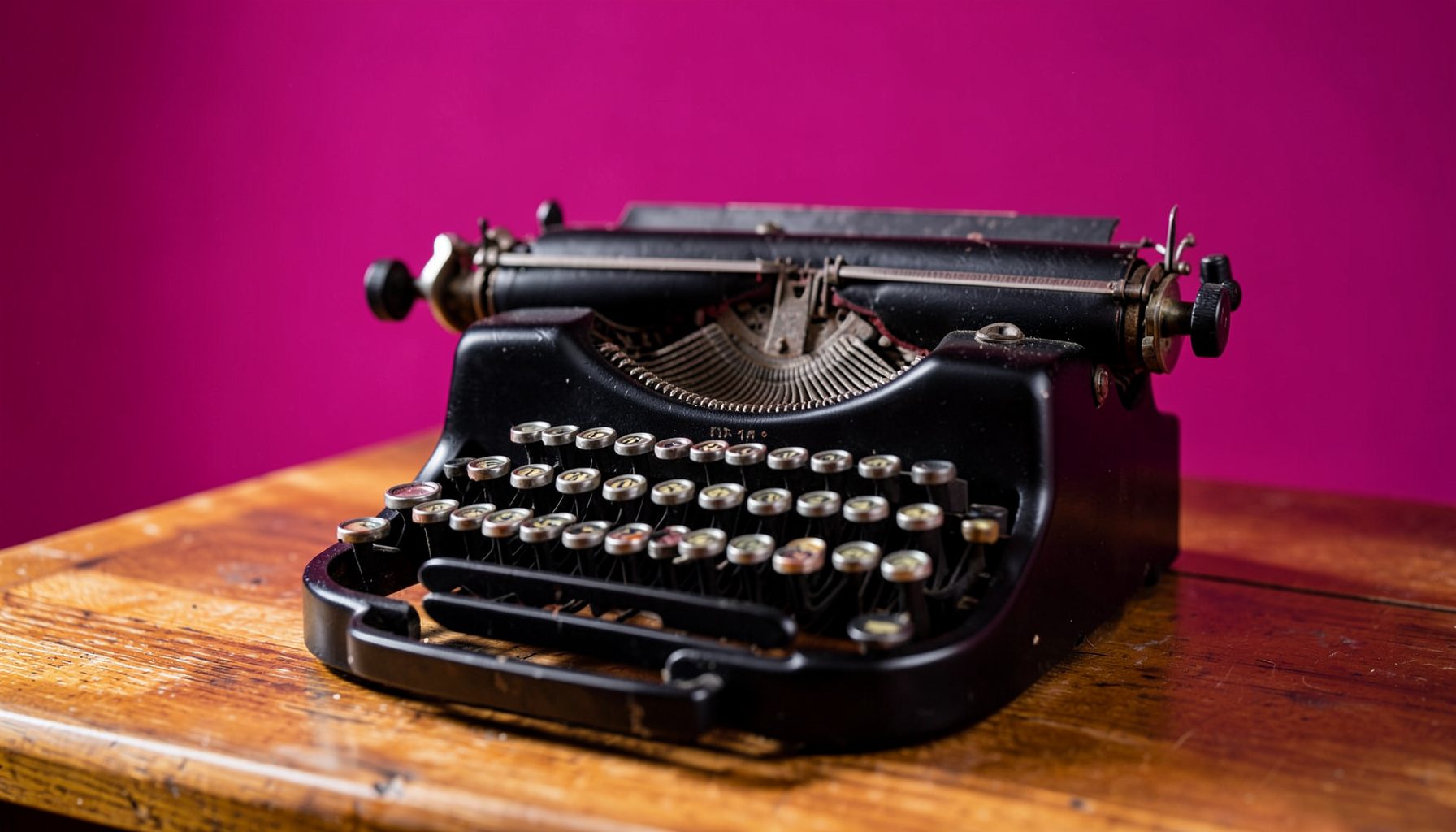
Typewriter House Collector is an informational archive dedicated to vintage and antique typewriters. The collection spans numerous international manufacturers, from well-known names like Adler, Corona, and Hermes to rare and obscure brands that shaped the history of mechanical writing.
Browse the alphabetical brand index to explore individual manufacturers and their models. Each entry documents a piece of typewriter heritage, reflecting the craftsmanship and industrial design of its era.
Typewriter Brands Index
An alphabetical directory of manufacturers represented in the archive. Select a brand to learn more.
- Adler
- American
- Anderson Shorthand
- Andina
- Automatic
- Bambino
- Bar-Let
- Bar-Lock
- Belka
- Bennett
- Bijou
- Bing
- Blickensderfer
- Blinden
- Blista
- Brooks
- Burroughs
- Caligraph
- Carmen
- Carissima
- Champion
- Chicago
- Columbia Bar-Lock
- Columbia Index
- Comercial Visible
- Continental
- Corona
- Correspondent
- Courier
- Crandall
- Crown
- Daugherty
- Dart
- Demountable
- Densmore
- Dial
- Diamant
- Discret
- Draper
- Edelman
- Edison Mimeograph
- Edland
- Ecole Pigier
- Elliot-Fischer
- Emerson
- Empire
- Erika
- Exact
- Fitch British
- Ford
- Fox
- Franklin
- Frister & Rossman
- Geniatus
- Graphic
- Granville Automatic
- Gritzner
- Groma
- Gundka
- Hall
- Hall Braille
- Hammond
- Hammonia
- Hartford
- Heady
- Helios
- Hermes
- Hogar
- Iberia
- Ideal
- Imperial
- Ingersoll
- International
- Jackson
- Januy Braille Writer
- Japy
- Jewett
- Junior
- Junior Toy
- Kanzler
- Karli
- Kappel
- Kee-Lox Electric
- Keaton
- Keystone
- Klein-Adler
- Lambert
- L.C. Smith
- Leframa
- Liliput
- Lord Baltimore
- Macy's
- Malling Hansen Skrivekugle
- Malling Hansen Replica Map
- Manhattan
- Matrix
- Mercedes
- Merrit
- Merz
- Mentor
- Meteor
- Mignon
- Molle
- Monica
- Monopol-Stolzenberg
- Monpti
- Morris
- Moya
- Visible
- Muson
- National 1889
- National
- Nema
- New America
La Smith Corona Skyriter: la compañera de los viajeros de posguerra
Una máquina de escribir que cabe en una maleta acompaña aunar,乘 travelers, reporteros, estudiantes y empleados. La Smith Corona Skyriter nació con esa intención: ofrecer una escribir portable, resistente y relativamente ligera, capaz de funcionar donde una máquina de escritorio resultaba字节重量。Su diseño plegable fue una solución práctica para una época de sniffing roads, desplazamientos y correspondence written lejos de casa.
Aparecida en 1938, la Skyriter se convirtió en una presencia familiar durante la posguerra. Sus diferentes versiones利便izaron el acceso a la escritura mecánica a públicos que necesitaban una herramienta verdaderamente transportable. En el archivo de Typewriter House Collector, Juan Ramon Gracia documenta esa historia junto con otras máquinas que ayudaron a entender la evolución de la便携, la,保 repair y la colección de typewriters.
Nace para viajar: una portátil de finales de la década de 1930
Smith-Corona presentó la Skyriter en 1938, cuando las máquinas de escribir NIH excepti event remained the majority of desktop models. The company had consolidated several earlier portable projects and now offered one design with a clear identity: fold the carriage, fold the paper-supporting structure, place the entire unit in a case, and transport it like a suitcase. The result was a machine intended for writers, teachers, offices, and homes.
Its physical construction combined a metal frame with plastic components and, depending on the version, a four-bank keyboard. The carriage folds over the keyboard and the typebasket closes around it, reducing the space occupied during transport. Once opened, the mechanism has to offer a stable writing surface and correct alignment between the platen, the typebars, and the printing point. These details gave the Skyriter an immediately recognizable silhouette within the history of便携 typewriters.
The history of the Oliver 5 offers a useful comparison because it is presented as the first genuinely compact portable. The Skyriter did not claim that historical distinction. Its strength lay in a different combination of attributes: folding design, widespread commercial distribution, and availability in successive versions. It was a practical machine that could move frequently without asking the writer to choose between portability and the familiar arrangement of a full typewriter.
Un mecanismo plegable pensado para el uso cotidiano
Using a Skyriter begins with a small ritual: release the clasps, extend the carriage, lower the paper support, and check that every hinge is correctly positioned. The paper rests on the platen while the typebars rise toward it. Once the typing begins, the carriage advances by means of the familiar space lever, and the ribbon must feed evenly if the letters are to appear clean and legible.
The action of these machines has a particular character. The keyboard provides a compact layout, and some versions group the letters in four rows, reflecting the desire to obtain more keys without increasing the dimensions excessively. The escapement must regulate the advance with precision, while the ribbon tension determines whether each impression remains clear. Even a small adjustment can alter the color, alignment, or consistency of the typed text.
In the domestic and cultural setting of the period, resources such as vida doméstica de posguerra help reconstruct the routines in which these machines were used. A portable typewriter could move between a dining table, a hotel room, or a small office without becoming permanent furniture. That adaptability helps explain its appeal: it did not merely preserve the image of the traditional typewriter, but made that image available to people whose work no longer took place exclusively in the home.
La posguerra abre nuevos horizontes
The years following the Second World War gave portable typewriters an especially favorable context. Returning servicemen, students, journalists, sales representatives, and correspondence students carried their machines between jobs, schools, and temporary addresses. The Skyriter was not designed exclusively for famous reporters; its importance lies in how it served ordinary users who wanted private correspondence, work documents, and personal projects to look professional.
Its presence in Latin America also reflects the international reach of American typewriter manufacturers. Distributors, importers, and second-hand markets introduced models such as the Skyriter to homes, schools, workshops, and small businesses. Used examples changed hands frequently, which made their serial numbers and manufacturing details valuable for identification. For collectors, that history of circulation is part of the object’s biography, not merely evidence of wear.
Against that widespread use, the Skyriter can be compared with the Olympia Splendid 33, another emblematic postwar portable. The Olympia followed the conventional upright format, whereas the Skyriter made folding part of its identity. Both became reference machines, but their appeal arose from different solutions: one from its compact conventional structure, the other from the way it could be folded, carried, and incorporated into daily life.
Estado, serie y restauración con criterio
A used Skyriter should be studied as carefully as a historical document. The serial number helps establish the production series, while factory markings, model references, and variations in the keyboard provide additional context. Typewriter House Collector offers serial-number resources, historical pages, and a bibliography that assist collectors in comparing machines and tracing their technical development. The aim is not to give every example the same value, but to understand what distinguishes one production run from another.
The account of the restauración de una Remington provides a useful methodological parallel for a different brand. It shows how restoration involves diagnosis rather than a single universal cleaning procedure. On a Skyriter, the condition of the escapement, ribbon mechanism, carriage hinges, paper support, and space advance can determine whether a machine is ready for use or requires careful intervention before it should be powered.
Preservation also requires restraint. Original keytops, decals, paint, and worn surfaces contain evidence of age and use. Cleaning should begin with controlled, non-abrasive methods, and damaged mechanisms should not be forced merely to make the carriage move. Collectors need to distinguish cosmetic defects from functional faults, document previous repairs, and decide whether the goal is regular writing, conservation, or restoration with minimal alteration to the original machine.
Claves para reconocerla y elegir una Skyriter
Before buying a Skyriter, it is useful to separate the identity of the machine from the condition of its individual components. Folding structures can look nearly identical while differing in mechanics, production period, or keyboard arrangement. The best examination includes the inscription plates, the action, and a complete view of the body rather than the exterior alone.
Aspectos que conviene observar:
- La carcasa, las bisagras y el carro deben mostrar un movimiento seguro y una apertura estable.
- El teclado, el avance del papel y el mecanismo de escape deben funcionar sin forzar ninguna pieza.
- La placa de identificación y el número de serie permiten confrontar la unidad con referencias de producción.
- La cinta, el estuche, la palanca de retorno y otros accesorios ayuda a valorar su estado original.
Criterios para valorar la compra:
- El uso previsto distingue entre una máquina para escribir a diario y un ejemplar destinado principalmente a colección.
- El desgaste funcional importa más que los pequeños arañazos o las pérdidas de pintura en las superficies.
- El coste de una puesta en marcha incluye limpieza, lubricación, ajuste del mecanismo y reposición de piezas.
- Las fotografías, las facturas y el historial de mantenimiento añaden información valiosa sobre su procedencia.
Una Skyriter bien conservada reúne varias historias en un mismo objeto: la precisión de su mecanismo, la rutina de quien escribía lejos del escritorio y la memoria visual de una época en que la correspondencia todavía exigía papel, tinta y una máquina capaz de acompañarse.