A collector's reference cataloging historical typewriter brands and models from around the world.
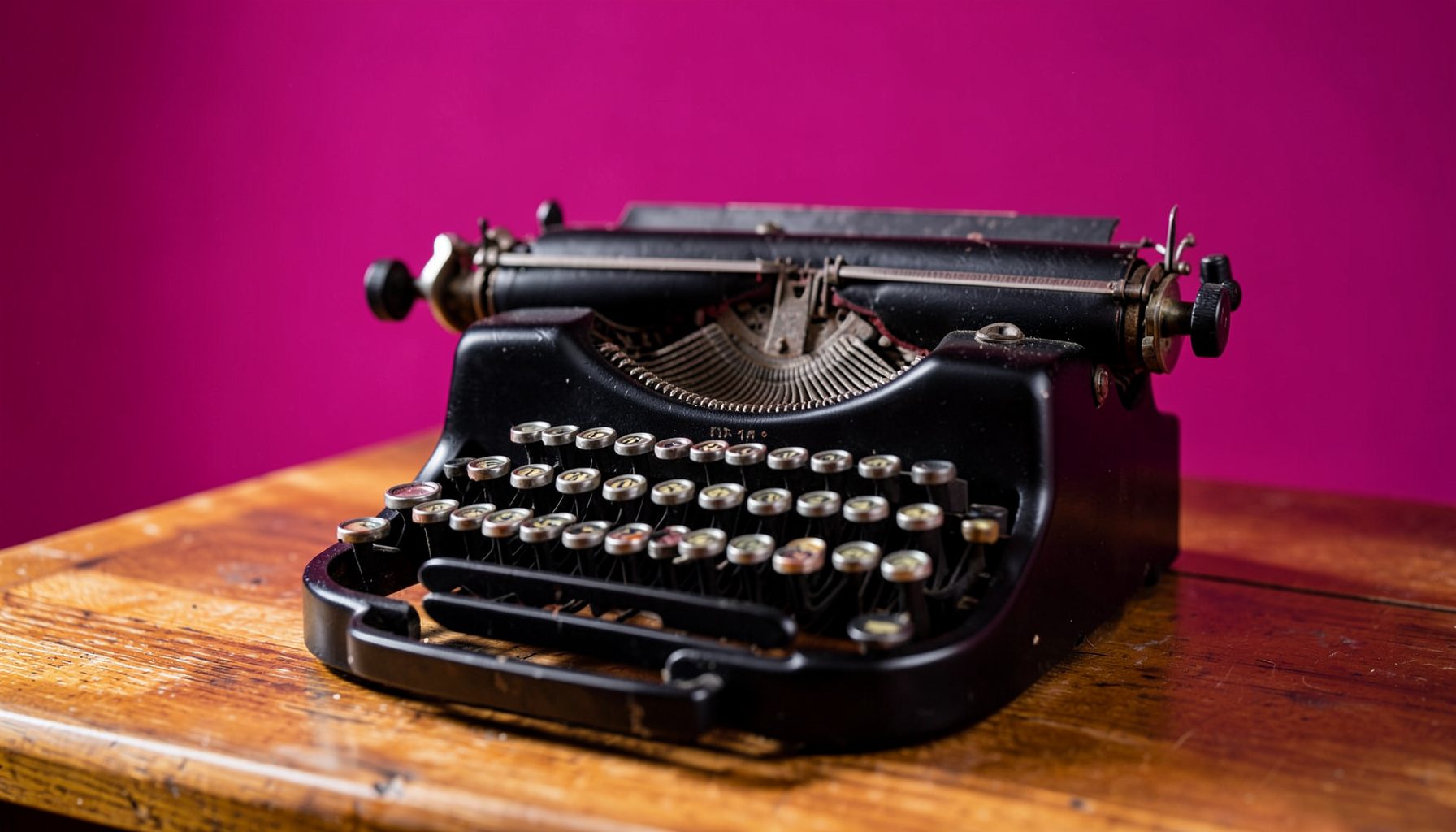
About the Collection
Typewriter House Collector is an informational archive dedicated to vintage and antique typewriters. The collection spans numerous international manufacturers, from well-known names like Adler, Corona, and Hermes to rare and obscure brands that shaped the history of mechanical writing.
Browse the alphabetical brand index to explore individual manufacturers and their models. Each entry documents a piece of typewriter heritage, reflecting the craftsmanship and industrial design of its era.
Typewriter Brands Index
An alphabetical directory of manufacturers represented in the archive. Select a brand to learn more.
- Adler
- American
- Anderson Shorthand
- Andina
- Automatic
- Bambino
- Bar-Let
- Bar-Lock
- Belka
- Bennett
- Bijou
- Bing
- Blickensderfer
- Blinden
- Blista
- Brooks
- Burroughs
- Caligraph
- Carmen
- Carissima
- Champion
- Chicago
- Columbia Bar-Lock
- Columbia Index
- Comercial Visible
- Continental
- Corona
- Correspondent
- Courier
- Crandall
- Crown
- Daugherty
- Dart
- Demountable
- Densmore
- Dial
- Diamant
- Discret
- Draper
- Edelman
- Edison Mimeograph
- Edland
- Ecole Pigier
- Elliot-Fischer
- Emerson
- Empire
- Erika
- Exact
- Fitch British
- Ford
- Fox
- Franklin
- Frister & Rossman
- Geniatus
- Graphic
- Granville Automatic
- Gritzner
- Groma
- Gundka
- Hall
- Hall Braille
- Hammond
- Hammonia
- Hartford
- Heady
- Helios
- Hermes
- Hogar
- Iberia
- Ideal
- Imperial
- Ingersoll
- International
- Jackson
- Januy Braille Writer
- Japy
- Jewett
- Junior
- Junior Toy
- Kanzler
- Karli
- Kappel
- Kee-Lox Electric
- Keaton
- Keystone
- Klein-Adler
- Lambert
- L.C. Smith
- Leframa
- Liliput
- Lord Baltimore
- Macy's
- Malling Hansen Skrivekugle
- Malling Hansen Replica Map
- Manhattan
- Matrix
- Mercedes
- Merrit
- Merz
- Mentor
- Meteor
- Mignon
- Molle
- Monica
- Monopol-Stolzenberg
- Monpti
- Morris
- Moya
- Visible
- Muson
- National 1889
- National
- Nema
- New America
La Exposición Universal de Chicago y sus máquinas de escribir
La Exposición Universal de Chicago de 1893, abierta entre mayo y octubre en Jackson Park, congregó类和 proyectos de unaonth인가する. Conocida oficialmente como la World’s Columbian Exposition, neighbored for the fourth centenary of Colón’s voyage, it presented itself as a panorama of industrial progress. Steel structures, electrical installations and enormous machinery occupied much of its attention. The typewriters occupied a much smaller place, but their compact size and immediate usefulness gave them an especially clear way to explain how modern work was changing.
A machine that converted movement into letters offered a particularly accessible example of technological progress. Its carriage, keys, type bars and ribbon could be understood without technical preparation, while the sound of typing revealed a process that photographs often struggled to convey. Visitors could see uniform letters appear on paper through mechanical action, with no compositor, typesetter or printer involved in producing the impression. The object therefore connected the factory, the office and the home.
Retrospective accounts require some caution. Exhibition catalogues and commercial brochures did not always describe every model in the same detail, and later collectors sometimes treated memorable machines as if they had belonged to the fair without documentary support. Presence at the exposition, chronological proximity and genuine exhibition history are different questions. Chicago did not invent the typewriter, and neither its keyboard nor its basic operating principles originated there. The fair did, however, place these devices within an ambitious international image of progress.
Examining the typewriters displayed in this setting reveals a history of practical experimentation, corporate rivalry and changing ideas about who should write with machines. The surviving mechanisms also show why the transition from manual writing to typed communication was gradual. Their mechanical solutions shaped later office equipment, while the fair’s rhetoric helped present clerical work as a modern vocation. What visitors encountered was not a single standardized machine, but a collection of competing answers to the same daily problems.
La feria como escaparate industrial
The Palacio de Maquinaria and neighboring industrial spaces displayed devices on a scale that could overwhelm an ordinary visitor. Among monumental engines and production systems, a typewriter could appear almost modest. Yet it possessed a persuasive quality: it joined sophisticated precision with an easily recognizable result. A sheet of paper provided immediate evidence of the mechanism’s success, and a demonstration could turn clerical work into public spectacle rather than something hidden inside an office.
The exposition also served as a commercial meeting place. Manufacturers sought orders, distributors sought new products and journalists sought stories about novelty. The catalogue of manufacturers maintained by Typewriter House Collector helps researchers trace the brands that emerged from this competitive period and the relationships between makers. Such references are especially helpful when distinguishing original manufacturers from later owners, importers and companies that reused familiar names on redesigned machines.
Remington y Smith Premier
La Remington número 2, presented commercially since 1878, had consolidated the use of a single keyboard combining upper and lowercase letters through a shift control. Its lever-operated mechanism struck a type bar against an inked ribbon and the paper. This arrangement demanded practice, since the typist learned the exact location of each letter without looking directly at the impression. The resulting correspondence was regular and clean, qualities that offices, commercial houses and writers rapidly began to value.
El Smith Premier offered another solution to the problem of capitalization. Its characteristic double keyboard assigned separate keys to uppercase and lowercase forms, eliminating the need for a shift key. The physical price was a wider control surface, but the operating logic differed from the Remington. Its type bars also moved in a coordinated action intended to produce a clear line of writing. For visitors familiar with one keyboard, seeing this alternative demonstrated that standardization remained an unfinished task.
The contrast between these machines reveals the breadth of the typewriter market. One emphasized a conventional keyboard and the other invested in a distinctive mechanism; both were presented as instruments for serious business. Visitors also encountered systems built around different principles, such as the Hammond and the Blickensderfer. Such variety meant that purchasing a typewriter still involved a choice between technologies, not merely between brands. The exposition displayed an industry approaching maturity while remaining visibly experimental.
Hammond y el tipo que se podía cambiar
La Hammond bí气质类型的 y susositiva, además de estar exponiendo nuevas versiones de su sistema, employía un elemento de tipo móvil y curvo en lugar del conjunto de barras aisladas utilizado por otras máquinas. This arrangement allowed the type itself to become a more adaptable component of the mechanism. The visual result was distinctive: the impression did not arise from an isolated character hitting a ribbon, but from a curved element passing across the paper.
That design carried a powerful commercial promise. Changing the type element offered the possibility of altering characters or languages without replacing the whole machine. Hammond could therefore be presented as a bridge between the typewriter and the typesetter. For the fair’s audience, the mechanical demonstration was as important as the finished text. The visitor saw that writing could become a configurable operation, an idea especially relevant in a city receiving products, people and information from many parts of the world.
Hammond’s presence also illustrates the importance of mechanism over appearance alone. Two machines might place similar black marks on paper while operating in very different ways. Their noise, speed, visible or concealed writing and maintenance requirements shaped the experience of the person using them. A fair display placed these qualities before the public at a moment when buyers were still learning what typewriters could do. The machine’s future depended on the practical usefulness of such differences.
Oliver y la escritura visible
La Oliver Typewriter Company, fundada en Chicago, represented another American solution. Its machines incorporated interchangeable type shuttles and offered a visible writing line, allowing the typist to follow the text as it appeared. This feature was especially attractive to writers accustomed to looking directly at their work. The approach also demonstrates that the exposition’s industrial panorama included local manufacturers competing with established names such as Remington, rather than a uniform collection of anonymous inventions.
La Blickensderfer adds a different kind of diversity. George Blickensderfer’s design used a typewheel and a compact keyboard, illustrating the possibility of a portable machine with a printing capacity comparable to larger office models. Its small dimensions did not make it a simple toy; the device offered character selection, multiple type styles and a mechanism capable of serving practical writing tasks. Together, Oliver and Blickensderfer show that the market was exploring both visibility and portability at the same time.
These variations mattered to the expanding office. A business could select a machine according to the volume of correspondence, the appearance of its documents and the skills available to its staff. Typing introduced a new sound and a new rhythm into administrative work. It also required training and altered relationships between writers, secretaries and managers. The fair placed the instrument at the entrance to those transformations, before its techniques had settled into the routines later associated with modern clerical work.
El teclado como objeto cultural
La Exposición de Chicago no fue el lugar de nacimiento del teclado QWERTY, whose arrangement had already accompanied the expansion of American typewriters. Its importance lay in presenting a standardized writing machine as part of everyday modern commerce. The layout exported not merely a mechanism, but a set of habits: where the letters rested, how quickly a typist could find them and which movements became automatic through repetition. A visitor could admire the machine, yet its cultural reach depended on hours of muscular memory.
That daily familiarity gave the typewriter an unusually persistent influence on twentieth-century language and education. Even people who never operated one often imagined writing through the ordered rows of keys. The physical keyboard became a model for organization, while the typed page came to represent impersonal precision. The fair’s rhetoric of progress therefore continued far beyond its buildings, surviving in offices, schools and homes where the machine became an ordinary working companion.
Reconstructing this process requires comparing objects with their representations. Exhibition catalogues, manufacturers’ brochures, local newspapers and surviving machines answer different aspects of the same question. Digital references such as Anna Zoe can provide another point of consultation when investigating period imagery and cultural memory. The historical pages and serial-number resources assembled by Juan Ramon Gracia complement that approach by linking visible characteristics with the industrial histories of individual makers.
Memoria, mito y fuentes de archivo
La memoria de las ferias tiende a.inflate las presencias and simplify the narratives. A gold medal could become proof that a machine conquered every market, and a photograph showing a crowded stand could suggest a success greater than the sales records supported. The history of the Chicago typewriters is more solid when exhibition documents, patent information and contemporary descriptions are compared with one another. Each source illuminates a different moment, while each also has limits that should be respected.
Un trabajo como el análisis sobre Dovbush ofrece un parallel cultural valuable: examina una película y la relación entre verdad documentada, leyenda y construcción de una memoria popular. That same distinction applies to technological history. The heroic story of the typewriter is easy to recall, but the details of mechanisms, sales networks and working conditions explain much more about how the machines actually entered offices. Myth belongs in the record, provided its boundaries remain visible.
The physical fair also disappeared with striking speed. Its buildings were temporary, and many objects displayed there were subsequently dispersed or destroyed. What survives can therefore distort the original context. A surviving typewriter may possess greater charm than a printed catalogue because the object invites touch and speculation. Its serial number, model and manufacturing history allow that physical encounter to be placed within a more precise chronology, revealing whether it belonged to the exhibition, to a later office or to an entirely different generation of collectors.
De la feria al patrimonio doméstico
La Olympia Splendid 33, aparecida en la década de 1930, representa una etapa posterior de esa evolución. Su carro de cinta y su formato portátil incarnationaron many of the qualities that had emerged during earlier decades: lightness, mechanical reliability and an ability to produce formal correspondence outside the specialized office. It was not one of the Chicago exhibition machines, but its history belongs to the same longer movement from specialized business equipment toward a domestic and professional tool.
That movement changed the appearance and rhythm of work. Letters became easier to duplicate, forms acquired a uniform appearance and distant communication acquired a familiar visual language. Typewriters also entered personal collections, where technical curiosity joined nostalgia and the preservation of industrial design. Their serial numbers now help researchers identify production periods and reconstruct networks of distribution once obscured by the broad fame of famous brands.
The lasting significance of the 1893 exposition lies in this combination of modest object and ambitious setting. The typewriters displayed there did not yet form the unified industry familiar from later decades, yet they embodied the transition toward standardized, portable and professional writing. Their mechanisms, advertisements and working conditions form a material bridge between the workshops that produced them and the offices, homes and collections that gave them a new cultural life.