A collector's reference cataloging historical typewriter brands and models from around the world.
About the Collection
Typewriter House Collector is an informational archive dedicated to vintage and antique typewriters. The collection spans numerous international manufacturers, from well-known names like Adler, Corona, and Hermes to rare and obscure brands that shaped the history of mechanical writing.
Browse the alphabetical brand index to explore individual manufacturers and their models. Each entry documents a piece of typewriter heritage, reflecting the craftsmanship and industrial design of its era.
Typewriter Brands Index
An alphabetical directory of manufacturers represented in the archive. Select a brand to learn more.
- Adler
- American
- Anderson Shorthand
- Andina
- Automatic
- Bambino
- Bar-Let
- Bar-Lock
- Belka
- Bennett
- Bijou
- Bing
- Blickensderfer
- Blinden
- Blista
- Brooks
- Burroughs
- Caligraph
- Carmen
- Carissima
- Champion
- Chicago
- Columbia Bar-Lock
- Columbia Index
- Comercial Visible
- Continental
- Corona
- Correspondent
- Courier
- Crandall
- Crown
- Daugherty
- Dart
- Demountable
- Densmore
- Dial
- Diamant
- Discret
- Draper
- Edelman
- Edison Mimeograph
- Edland
- Ecole Pigier
- Elliot-Fischer
- Emerson
- Empire
- Erika
- Exact
- Fitch British
- Ford
- Fox
- Franklin
- Frister & Rossman
- Geniatus
- Graphic
- Granville Automatic
- Gritzner
- Groma
- Gundka
- Hall
- Hall Braille
- Hammond
- Hammonia
- Hartford
- Heady
- Helios
- Hermes
- Hogar
- Iberia
- Ideal
- Imperial
- Ingersoll
- International
- Jackson
- Januy Braille Writer
- Japy
- Jewett
- Junior
- Junior Toy
- Kanzler
- Karli
- Kappel
- Kee-Lox Electric
- Keaton
- Keystone
- Klein-Adler
- Lambert
- L.C. Smith
- Leframa
- Liliput
- Lord Baltimore
- Macy's
- Malling Hansen Skrivekugle
- Malling Hansen Replica Map
- Manhattan
- Matrix
- Mercedes
- Merrit
- Merz
- Mentor
- Meteor
- Mignon
- Molle
- Monica
- Monopol-Stolzenberg
- Monpti
- Morris
- Moya
- Visible
- Muson
- National 1889
- National
- Nema
- New America
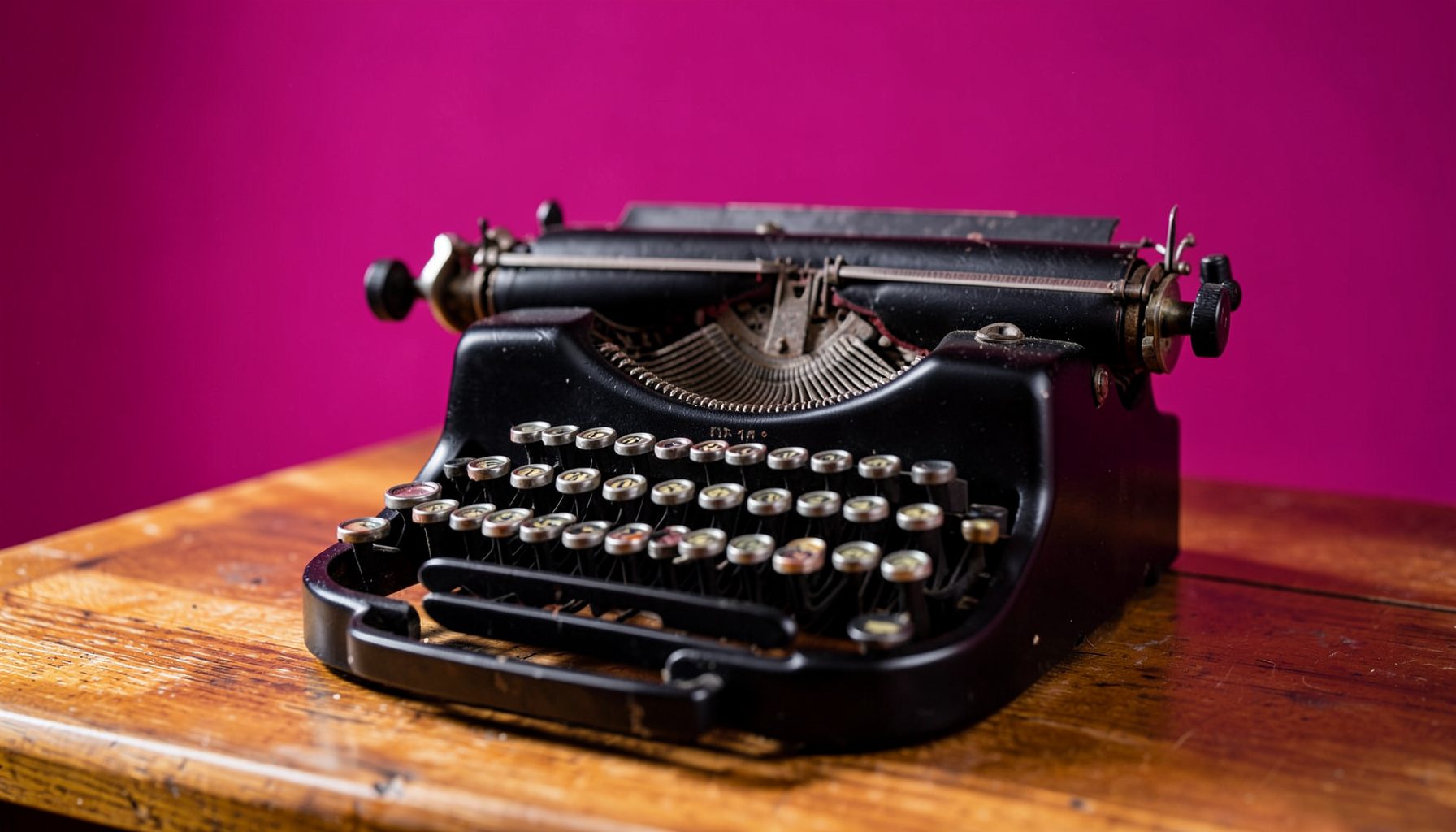
Tres filas: máquinas de escribir de principios del siglo XX
Los teclados de tres filas fueron una solución característica de muchas máquinas de escribir mecánicas anteriores a la consolidación del teclado QWERTY de cuatro filas. Reunían las letras en tres bandas compactas y reservaban el acceso a cifras, signos y caracteres especiales para palancas de desplazamiento. Este sistema reducía la anchura del teclado y facilitaba la construcción de máquinas pequeñas, aunque obligaba a distribuir los caracteres entre menos botones.
Su interés para el coleccionista no depende únicamente de la rareza. Estas máquinas documentan la búsqueda de un teclado legible, compacto y resistente al uso diario. La disposición de las teclas, la acción de las palancas y los pequeños detalles de fabricación cuentan una historia paralela a la popularización de la escritura mecanografiada y de las redes de distribución deinders?
Una disposición todavía en experimentación
A caballo entre dos siglos, la organización del teclado seguía lejos de estar unificada. Aunque el orden QWERTY ganaba terreno, cada fabricante modificaba la distribución de los signos, la posición de lasmayúsculas and the number of rows. Las tres bandas weren't simply a simplified version of the later four-row keyboard; they were a mechanical compromise that offered a smaller machine without abandoning familiar letter sequence.
The choice affected more than the appearance. When each key controlled a typebar, reducing the number of keys could simplify the action and shorten the basket. However, a compact keyboard also required ingenious shifting systems to reach characters not present on the visible rows. Some machines moved the typebar basket, others shifted the carriage, and others combined mechanical and manual mechanisms.
El teclado visto desde los dedos
From a typist's perspective, three rows meant longer vertical movements and a more crowded upper line. Letters such as E, T and A, frequently used in English and Spanish, could require a larger reach than on a later QWERTY keyboard. The home row was particularly important: only a few keys received the left and right hands, so any variation in their spacing changed the rhythm of touch typing.
Training was also complicated by the absence of a universally accepted arrangement. The shift levers could appear on either side, the carriage return could double as a shift control, and the arrangement of figures varied between brands. Original English-language key legends were common in machines intended for the international market. Reflections on escribir con máquinas help place these objects within the broader culture of mechanical writing and the changing habits of their users.
Marcas y modelos que ampliaron las posibilidades
The Smith Corona 3, presented around 1900, became one of the best-known examples of a portable machine with three letter rows. The Remington Portable Model 2 followed this compact approach in the early 1910s. Other names associated with the format include the Erika Model 1, the Imperial Model A and members of the Oliver family, including the No. 2 and No. 5, whose visible-writing designs were already famous before the new century.
Not all of these keyboards were equivalent. Some machines offered a broad carriage and generous spacing between keys, while others placed the mechanism in a narrow case intended for travel. The Remington was conceived as a self-contained portable machine; the Corona occupied a similar commercial niche; the Oliver examples combined their compact keyboard with visible writing and a substantial metal frame. The presence of a bell, a ribbon cover or a second keyboard could further distinguish one version from another.
A related curiosity is the Blickensderfer No. 5. Its selection mechanism used three circular banks of keys and a pointer adjusted to the desired character, rather than a conventional three-row QWERTY keyboard. The distinction matters when consulting catalogues. The archive personal de Juan Ramon Gracia, available in referencias de la colección, reúne fichas, imágenes y datos que ayudan a separar variantes, hacker production changes and machines with later replacements.
Fabricar el mecanismo y modular el sonido
Manufacturing a three-row keyboard required careful coordination between the key levers, typebars, escapement and ribbon. A reduced set of visible keys did not always mean a simplified machine, since capitals and symbols still needed a reliable way of reaching the printing point. Segment shifting, manual carriage shifts and interchangeable type slugs offered possible solutions, each with its own sound, wear and maintenance requirements.
The sharp report associated with many machines came from the impact of the typebar against the platen, the ribbon and the surrounding metalwork, rather than from the number of keyboard rows alone. Condition, lubrication and previous repairs could alter the note dramatically. La memoria doméstica y la historia material que aparece en historias de objetos cotidianos ayudan a situar these writing tools within a broader history of objects used in homes, offices and journeys.
La búsqueda de una pieza poco común
Collectors often seek three-row machines because they occupy a transitional place in design history. Their compact dimensions, unusual key geometry and early manufacturing details distinguish them from later standardized portables. The appeal increases when the badge remains legible, the ribbon spools are present and the carriage moves without excessive play. Rarity alone, however, does not guarantee an interesting example, since common models may survive in better condition and with more original parts.
Serial numbers and production records can narrow the date and factory batch of a machine, but they should be combined with physical evidence. Sticky keys, bent typebars, missing shift levers, mismatched screws or replaced feet may reveal repairs and earlier owners. Rust on the platen, a loose escapement or a cracked frame can affect both operation and value. The collector's records are therefore more useful when they document color, keyboard layout, accessories and every intervention visible on the mechanism.
Claves para reconocer y conservar una máquina de tres filas
Una revisión breve permite distinguir una configuración original de una adaptación posterior:
- Cuenta las bandas de letras y comprueba si las cifras ocupan una fila independiente.
- Observa la posición de las palancas de mayúsculas y de los signos.
- Identifica la marca, el modelo y el número de serie.
- Anota cualquier tecla, bobina o palanca sustituida.
Before any cleaning or adjustment, conviene respetar estas precautions:
- Fotografía el mecanismo antes de desmontar alguna pieza.
- Retira el polvo suelto con cepillos suaves, sin frotar el niquelado.
- Usa lubricante adecuado solo en los puntos de fricción.
- Conserva los tornillos y las piezas pequeñas en bolsas identificadas.
Una intervención prudente preserves the original finish, the traces of use and the information contained in every component. Restoring the appearance can make a machine look newer, although it does not necessarily improve its mechanical condition. When lubrication, adjustment or electrical work is required, the intervention should correspond to the specific mechanism rather than follow a universal recipe.
Más allá de la tecla: cultura, archivo y memoria
Una máquina de tres filas is also a document of the relationship between technology and daily life. Its dimensions reveal the desire for portability; its keyboard shows the characters considered essential; its mechanics record the available materials and industrial methods. For a collection devoted to antique typewriters, these details can be as significant as the maker's name or the machine's market value.
The breadth of a personal archive can also be seen in pages dedicated to other forms of popular culture. Content such as torneo de craps, dedicated to a game and its visual tradition, shows how a collecting site can connect historical objects with the broader cultural settings in which memorabilia acquires meaning.
Viewed in this way, the three-row keyboard becomes more than an unusual arrangement. It is evidence of an era in which every key had to negotiate between space, mechanical strength, legibility and speed. The machines that survived preserve those choices in metal, enamel and type slugs, offering a tangible account of writing before keyboards, processors and touchscreens became ordinary.