A collector's reference cataloging historical typewriter brands and models from around the world.
About the Collection
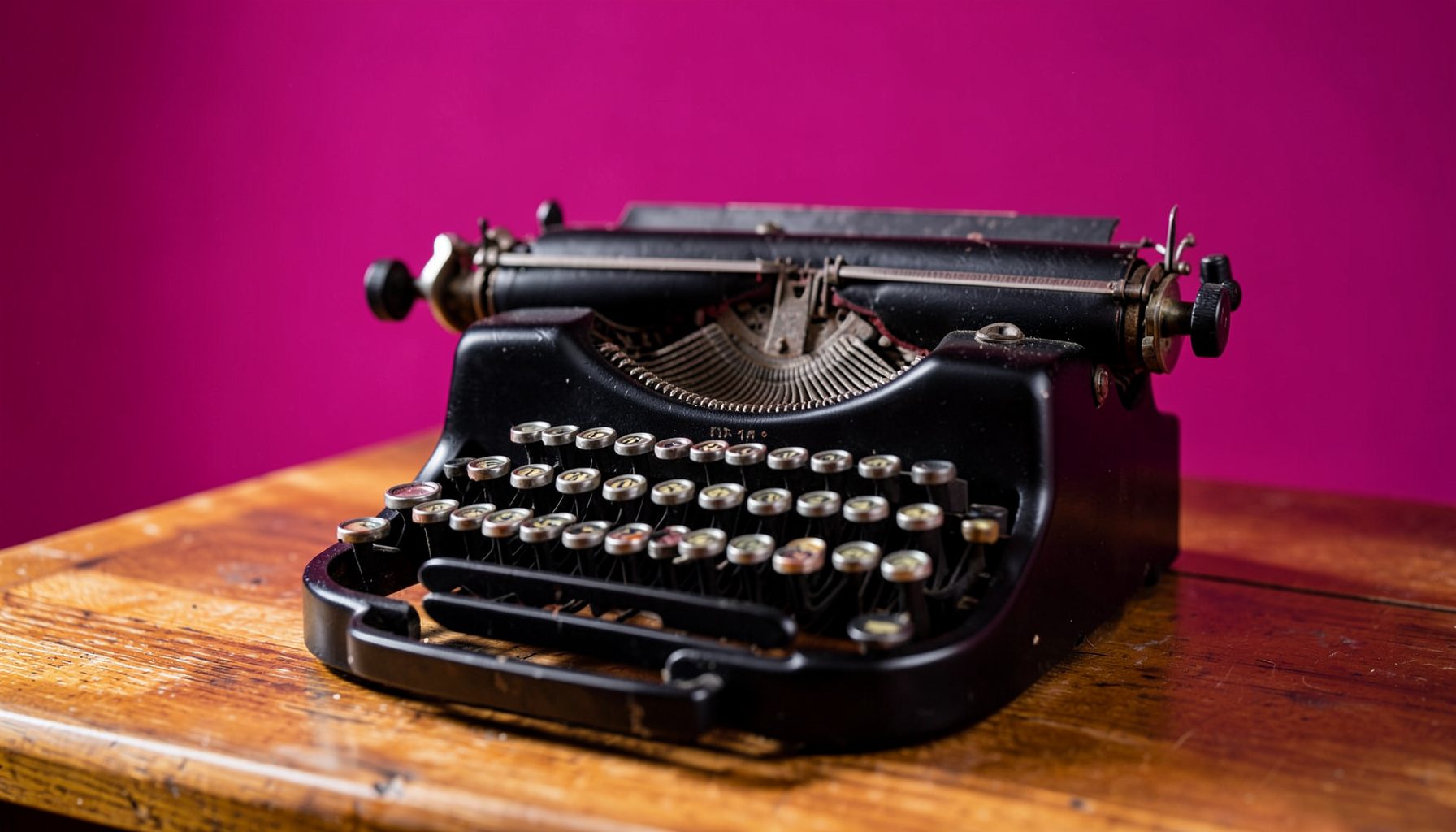
Typewriter House Collector is an informational archive dedicated to vintage and antique typewriters. The collection spans numerous international manufacturers, from well-known names like Adler, Corona, and Hermes to rare and obscure brands that shaped the history of mechanical writing.
Browse the alphabetical brand index to explore individual manufacturers and their models. Each entry documents a piece of typewriter heritage, reflecting the craftsmanship and industrial design of its era.
Typewriter Brands Index
An alphabetical directory of manufacturers represented in the archive. Select a brand to learn more.
- Adler
- American
- Anderson Shorthand
- Andina
- Automatic
- Bambino
- Bar-Let
- Bar-Lock
- Belka
- Bennett
- Bijou
- Bing
- Blickensderfer
- Blinden
- Blista
- Brooks
- Burroughs
- Caligraph
- Carmen
- Carissima
- Champion
- Chicago
- Columbia Bar-Lock
- Columbia Index
- Comercial Visible
- Continental
- Corona
- Correspondent
- Courier
- Crandall
- Crown
- Daugherty
- Dart
- Demountable
- Densmore
- Dial
- Diamant
- Discret
- Draper
- Edelman
- Edison Mimeograph
- Edland
- Ecole Pigier
- Elliot-Fischer
- Emerson
- Empire
- Erika
- Exact
- Fitch British
- Ford
- Fox
- Franklin
- Frister & Rossman
- Geniatus
- Graphic
- Granville Automatic
- Gritzner
- Groma
- Gundka
- Hall
- Hall Braille
- Hammond
- Hammonia
- Hartford
- Heady
- Helios
- Hermes
- Hogar
- Iberia
- Ideal
- Imperial
- Ingersoll
- International
- Jackson
- Januy Braille Writer
- Japy
- Jewett
- Junior
- Junior Toy
- Kanzler
- Karli
- Kappel
- Kee-Lox Electric
- Keaton
- Keystone
- Klein-Adler
- Lambert
- L.C. Smith
- Leframa
- Liliput
- Lord Baltimore
- Macy's
- Malling Hansen Skrivekugle
- Malling Hansen Replica Map
- Manhattan
- Matrix
- Mercedes
- Merrit
- Merz
- Mentor
- Meteor
- Mignon
- Molle
- Monica
- Monopol-Stolzenberg
- Monpti
- Morris
- Moya
- Visible
- Muson
- National 1889
- National
- Nema
- New America
Ornamentación y mecanismos de las máquinas de escribir victorianas
La máquina de escribir de la época victoriana fue algo más que un instrumento para colocar letras sobre papel. Durante la segunda mitad del siglo XIX, su estructura combinó precisión industrial, mecanismos de escape,(carruajes meticulously and a ornaments inspired by the decorative taste of the time. Su evolution reveals how Victorian aesthetics and technical needs converged in objects that were both useful and persuasive.
Many of these machines preserve the tensions of their historical moment. Their polished brass surfaces, curved profiles and floral motifs were accompanied by levers, springs and racks that demanded careful adjustment. The surviving examples also provide valuable evidence about manufacturing, office work and domestic life. Their mechanisms and ornamentation can therefore be studied together, as if they were two forms of testimony from the same period.
Orígenes mecánicos dentro de la era victoriana
The rise of typewriters coincided with the consolidation of Victorian industrial culture. Although writing machines had been imagined earlier, their sustained commercial development began during the second half of the nineteenth century. The 1860s saw the appearance of the first widely recognized machines associated with Christopher Latham Sholes, Carlos Glidden and Samuel W. Soulé. Their fundamental achievement was to make the written line appear directly before the typist.
This system of visible writing differed from the mechanisms of earlier attempts, which could hide their results. In the Sholes design, pressing a key released a typebar carrying a raised character. The carriage moved horizontally while the bar struck the ribbon and paper. The result was faster than writing by hand, although the machine initially lacked many of the features later users considered indispensable.
As production expanded, different manufacturers and countries developed alternative architectures. Remington introduced its domestic model in 1878, while European makers offered machines with distinct escapements, typebar arrangements and keyboard layouts. The Victorian period thus produced not a single standardized mechanism, but a varied mechanical culture. Ornamentation often accompanied these technical experiments, disguising gears, levers and springs with forms designed to attract buyers.
El gusto decorativo del final del siglo XIX
During the last decades of the century, the appearance of a typewriter became essential to its commercial presentation. Manufacturers applied black japanned metal, polished nickel, brass, engraved plates and mother-of-pearl details. Curved supports, floral decals and shaped keytops gave many machines a furniture-like appearance, transforming office equipment into a decorative object for the home as well.
These details followed the visual conventions of the period, where pattern and surface could communicate refinement. The example of plegado con botones illustrates a similar relationship between construction and presentation: controlled folds create volume, while a carefully positioned fastening completes the design. Typewriters used analogous strategies, arranging mechanical necessity within balanced curves and repeated ornamental motifs.
Decoration was not merely superficial, however. Plaques bearing the maker’s name established trust, while shaped covers could conceal the mechanism and protect delicate moving parts. The most successful designs integrated their technical complexity into the object’s visual identity. Some machines resemble miniature pieces of furniture; others expose levers and bars with an almost scientific directness. The coexistence of both approaches reveals the changing relationship between industrial confidence and Victorian taste.
Carro, escape y barras de tipos
The most recognizable mechanism consisted of the platen, the carriage, the ribbon and the typebar assembly. The platen was the cylindrical roller around which the paper was wound. Above it, the ribbon presented ink to the character, while the carriage advanced across the line as each key was pressed. Even the familiar arrangement contained solutions to problems of alignment, tension and timing.
The escapement governed this movement with remarkable precision. A rack and pawl mechanism released the carriage one space at a time, preventing it from moving farther than the selected key required. After a stroke, the typebar returned to its resting position so that it would not disturb the next letter. In early machines, an additional control was needed to raise the correct character into printing position, which explains the considerable force demanded by the keyboard.
Alternative systems challenged the dominance of the typebar. The Blickensderfer, introduced in 1893, placed characters on a typewheel that rotated and shifted into position. Hammond machines employed a type shuttle, while cylinder systems attempted to combine large typefaces with a compact mechanism. These variants are valuable because they show how designers treated type selection, carriage movement and space advance as related but separable problems.
Manivelas, teclas y ergonomía
The keyboard became the meeting point between mechanical complexity and the typist’s body. QWERTY arrangements developed from the requirements of early typebar machines, since frequently used letters were placed where they could be struck without creating frequent collisions. Its adoption was gradual, and contemporary keyboards still differed considerably. Nevertheless, the familiar order emerged from an effort to reduce jams and increase the rhythm of sustained writing.
Controls surrounding the keyboard also changed how the machine was used. A carriage-return lever moved the platen to the beginning of the next line, while margin stops limited its travel. Some machines included bells that announced the approach of the right margin, and others offered frontstroke and backspace mechanisms. These additions addressed a practical reality: a technically successful writing system still had to be manageable during hours of clerical work.
The tactile experience of these machines deserves more attention than their photographs often allow. Keys travelled through distinct stages of resistance and release, and the noise of the escapement formed a regular cadence beneath the text. Contemporary resources such as creaciones de Happy Things provide a useful point of comparison with modern maker culture, in which repair, material knowledge and visible construction continue to shape the relationship between person and mechanism.
Portabilidad y reducción del tamaño
The classic Victorian typewriter was generally substantial, with a broad base, an elevated carriage and a structure intended to remain on a desk. Its weight contributed to the impression of permanence associated with offices and professional households. Portability existed as a secondary consideration, and the first portable models often sacrificed stability or typing speed to reduce size.
The transition became more visible around the end of the nineteenth century, when manufacturers experimented with folding frames, narrower carriages and more compact typebar systems. Some machines could be packed into cases, while others were designed for travelling salesmen or private correspondence. These changes transformed the typewriter from a fixed monument of commercial life into an object that could accompany its owner.
The postwar Groma Kolibri portátil demonstrates how far this evolution would proceed. Its reduced dimensions, plastic body and simplified construction differ considerably from the ornate Victorian examples, yet the same essential actions remain visible: selecting a character, releasing a mechanism and advancing the carriage. The contrast clarifies that ornament and size are historical choices rather than permanent features of the typewriter.
Identificación, series y conservación
Collectors often begin by identifying the maker, model and serial number, but these data require careful interpretation. Numbers were not always assigned in a simple, uninterrupted sequence. A factory could introduce a new numbering system, distribute production among different workshops or alter the format midway through a manufacturing run. Patent markings, typefaces, ribbon-spool dimensions and mechanical layouts frequently provide more reliable evidence than the serial number alone.
Documentation is especially valuable when a machine has been repaired or modified. Replacement keys, non-original platen cushions, altered carriage mechanisms and repainted frames may affect both operation and appearance. Recording these interventions allows a later owner to distinguish historical features from later conservation work. The archivo Typewriter House offers model descriptions and serial-number resources that can help establish a machine’s identity and place it within a production series.
Conservation must balance mechanical function with material integrity. Cleaning should remove dirt without erasing plating, decals or the patina of aged brass. Lubrication needs to reach moving surfaces without staining the paper path or attracting dust. Original surfaces, even when worn, often retain more evidence than a freshly polished replacement. The most informative machines are therefore those whose mechanisms remain legible and whose history has not been concealed by excessive restoration.