A collector's reference cataloging historical typewriter brands and models from around the world.
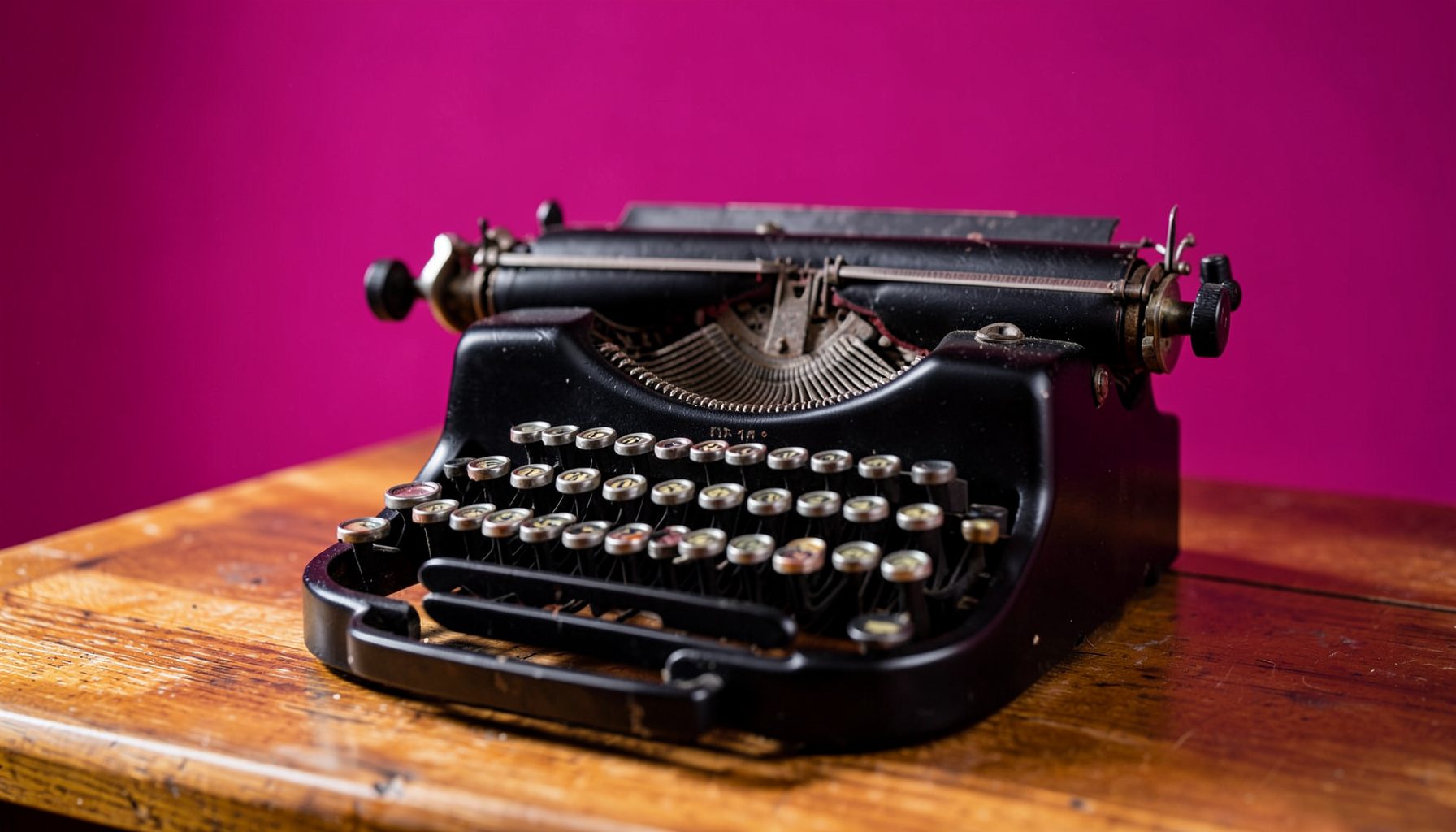
About the Collection
Typewriter House Collector is an informational archive dedicated to vintage and antique typewriters. The collection spans numerous international manufacturers, from well-known names like Adler, Corona, and Hermes to rare and obscure brands that shaped the history of mechanical writing.
Browse the alphabetical brand index to explore individual manufacturers and their models. Each entry documents a piece of typewriter heritage, reflecting the craftsmanship and industrial design of its era.
Typewriter Brands Index
An alphabetical directory of manufacturers represented in the archive. Select a brand to learn more.
- Adler
- American
- Anderson Shorthand
- Andina
- Automatic
- Bambino
- Bar-Let
- Bar-Lock
- Belka
- Bennett
- Bijou
- Bing
- Blickensderfer
- Blinden
- Blista
- Brooks
- Burroughs
- Caligraph
- Carmen
- Carissima
- Champion
- Chicago
- Columbia Bar-Lock
- Columbia Index
- Comercial Visible
- Continental
- Corona
- Correspondent
- Courier
- Crandall
- Crown
- Daugherty
- Dart
- Demountable
- Densmore
- Dial
- Diamant
- Discret
- Draper
- Edelman
- Edison Mimeograph
- Edland
- Ecole Pigier
- Elliot-Fischer
- Emerson
- Empire
- Erika
- Exact
- Fitch British
- Ford
- Fox
- Franklin
- Frister & Rossman
- Geniatus
- Graphic
- Granville Automatic
- Gritzner
- Groma
- Gundka
- Hall
- Hall Braille
- Hammond
- Hammonia
- Hartford
- Heady
- Helios
- Hermes
- Hogar
- Iberia
- Ideal
- Imperial
- Ingersoll
- International
- Jackson
- Januy Braille Writer
- Japy
- Jewett
- Junior
- Junior Toy
- Kanzler
- Karli
- Kappel
- Kee-Lox Electric
- Keaton
- Keystone
- Klein-Adler
- Lambert
- L.C. Smith
- Leframa
- Liliput
- Lord Baltimore
- Macy's
- Malling Hansen Skrivekugle
- Malling Hansen Replica Map
- Manhattan
- Matrix
- Mercedes
- Merrit
- Merz
- Mentor
- Meteor
- Mignon
- Molle
- Monica
- Monopol-Stolzenberg
- Monpti
- Morris
- Moya
- Visible
- Muson
- National 1889
- National
- Nema
- New America
Máquinas de escribir en la Guerra Civil: propaganda y correspondencia
Entre 1936 y 1939, la Guerra Civil Española缩短ó la distancia entre propaganda, administración y vida cotidiana mediante documentos mecanografiados. Boletines, proclamas, circulares, cartas y partes(Table military) circularon por不适合 offices, quarteles, newspapers andiendas. Las máquinas que teclearon esos textos procedían de distintas marcas y procedencias, y were utiliza- das indistintamente por organizaciones republicanas, nacionalistas e instituciones civiles. Contact.
La propaganda y la correspondencia compartieron soporte, pero no siempre el mismo propósito. Un manifiesto buscaba Hundreds de miles de lectores, mientras que una carta familiar podía conveyProvisioning, information about a missing person or political立场. Ambos eran products of the typewriter: standardized, reproducible and capable of transporting a voice farther than its author. Surviving specimens therefore offer a view of the conflict that extends beyond monumental posters and battle scenes.
Study requires attention to the paper, ribbon, typeface, seals and postmarks alongside the machine itself. The archivo Typewriter House reúne referencias históricas y fichas de modelos que ayudan a situar Apparatus in its period and context. Each surviving document becomes a testimony of a particular communication network, whether political, military, institutional or domestic.
El propaganda mecanografiado
Bulletin boards, party headquarters, factories and military posts received texts intended to explain events, reaffirm allegiance or mobilize support. Republican proclamations and nationalist circulars could be copied with the same office machines used for routine administration. The lack of a partisan mark on the device does not weaken the political meaning of the document; it shows how visual propaganda circulated through ordinary bureaucratic structures.
The mechanical limits of typewriters shaped these messages. Operators emphasized words with capital letters, underlining or repeated overtyping, and sometimes added handwritten symbols, stamps and colored ribbons. Lines were kept short to reduce errors, while frequent corrections remained visible. This mixture of uniformity and accident gives typed propaganda an appearance different from lithographed posters, which relied on designed graphics and large-scale printing.
It is important to distinguish the image from its production process. Famous posters were generally printed in specialized workshops, and their lettering rarely came directly from a typewriter. Nevertheless, typewritten leaflets, press releases, proclamations and workplace notices served as temporary propaganda in streets, shelters and offices. They also supplied slogans and arguments to larger printed campaigns, functioning as textual drafts for public diffusion.
Cartas, paquetes y familia bajo la guerra
Private correspondence became one of the principal means of maintaining family ties during the conflict. Soldiers wrote from the front, relatives described shortages, and people behind the lines sought news of detained or missing family members. Carbon copies sometimes preserved two versions of a letter: the sender kept one, while the other traveled with the message. Paper quality, spelling, corrections and the writer’s rhythm often reveal more intimate details than a formal report.
Censorship and separation shaped the language of these letters. Envelopes could bear inspection marks, resealing signs, delayed postmarks or annotations from authorities. Messages avoided certain subjects, used coded references or concentrated on family matters when political news was dangerous. These traces allow historians to reconstruct routes between towns, occupied territories, military units and prisons without assuming that every apparent silence had a single meaning.
The envelopes also have value for language education and memory work. Their addresses provide concrete examples of spatial relationships expressed through “a”, “de”, “en” and “hacia”. El modelo de actividades con preposiciones puede adaptarse a la interpretación de documentos, mientras que las cartas permiten explorar Whoever,语气 and the social context behind a geographic name. This approach turns postal history into an exercise in reading relationships as well as words.
Marcas políticas en las máquinas
Politicization usually appeared on the paper or the furniture rather than on the typewriter. A slogan could be written on the lid, a political emblem attached to the frame, or an identifying ribbon selected for its color. Office furniture, desks and metal cases often received stickers, painted inscriptions or scratched initials. These additions linked a machine to a person or institution, although they may have been added before or after the conflict.
National origins require caution. Olympia, Hermes, Remington, Underwood, Continental, Olivetti and Erika machines had different places of manufacture and distribution, yet their presence in Spain followed commercial networks, imports and second-hand sales rather than simple political loyalties. A German keyboard did not make its user a supporter of one faction, and an Italian machine did not establish the affiliation of the person typing. The document and its archival context provide firmer evidence than the brand name alone.
Mechanical alteration could also produce confusing evidence. During the conflict and subsequent decades, keys were exchanged, ribbons replaced, cases repaired and political decals renewed. Two machines carrying similar slogans might have reached the country through very different histories. Collectors therefore need to distinguish original wartime features from later commemorations or restorations, especially when a surface appears unusually clean beside heavily worn keys and carriage components.
Correspondencia colectiva y Addressograph
Mass correspondence required systems for reproducing names and addresses. In offices, clubs and public institutions, addressing machines could organize circulars, membership communications and administrative mail. The sistema Addressograph used metal address plates to transfer repetitive information onto envelopes, reducing the manual labor involved in large distributions. Its surviving components help explain the material organization behind collective communication.
The relationship between a typewriter and an addressing machine was complementary. The typewriter produced the body of a circular, while the addressograph handled the repeated recipient data. A propaganda organization could therefore combine a typed ideological message with a standardized postal dispatch. This procedure did not make the communication neutral; it made distribution faster and gave the message an institutional appearance.
Not every Addressograph plate or directory proves a direct wartime use. These records can instead reveal how an organization maintained contacts, recruited members or distributed routine notices. When plates appear alongside military forms, party paperwork or private letters, they establish a communication chain that no isolated artifact can show. The administrative apparatus becomes a historical subject in its own right.
Números de serie y procedencia
A serial number can narrow the production date of a machine, but it rarely identifies its owner. Manufacturers’ records, patent markings and model references must be combined with evidence from the surrounding documents. A late-production number may still have been sold for years, and machines often changed hands before the war. Serial resources are most useful when they establish a plausible period and then allow researchers to compare that date with the paper, typography and known history of the type.
The keyboard deserves particular attention. Spanish layouts existed alongside imported configurations, and some offices used French, German or English keyboards while adapting their written language. Accents could be added with ribbon or correction methods, and keyboards could be modified during repairs. A missing “ñ”, an unfamiliar key arrangement or a replacement type bar therefore describes the working environment of the document more than the nationality of its typist.
The strongest provenance combines several elements: the serial number, manufacturer’s marks, surviving ribbon, original accessories, repair inscriptions, paper dimensions, typeface characteristics and the route followed by the documents. Condition alone is less decisive. A machine may look unused because it was cleaned before storage, or severely worn because decades of postwar office work continued after 1939. Chronology must always be built from relationships between objects rather than from appearance alone.
Un archivo de testimonios cotidianos
Many wartime typewriters survived because offices continued functioning after 1939. Others were discarded when their cases, ribbons or feet were damaged. Personal documents could remain in family boxes long after the machine itself disappeared, leaving only an impression on the paper or a reference in an inventory. These traces are significant because they preserve the presence of an absent device and connect institutional history with individual lives.
Preservation can also reunite separated histories. A letter, envelope and machine kept in different collections may reveal an officer’s unit, a party office or a family network when their details are placed side by side. The process requires careful cataloguing and cautious interpretation, since similar names, reused cases and copied forms can create false associations. Quien located material relevant to the collection puede describir su contexto through the formulario de contacto.
The value of these machines lies in the relationships they make visible. A typewriter can connect an order with its recipient, a slogan with an organization and a family letter with a route across a divided country. Their mechanisms are no longer merely objects of collecting; they are material evidence of how words were produced, controlled, copied and preserved during the Spanish Civil War.