A collector's reference cataloging historical typewriter brands and models from around the world.
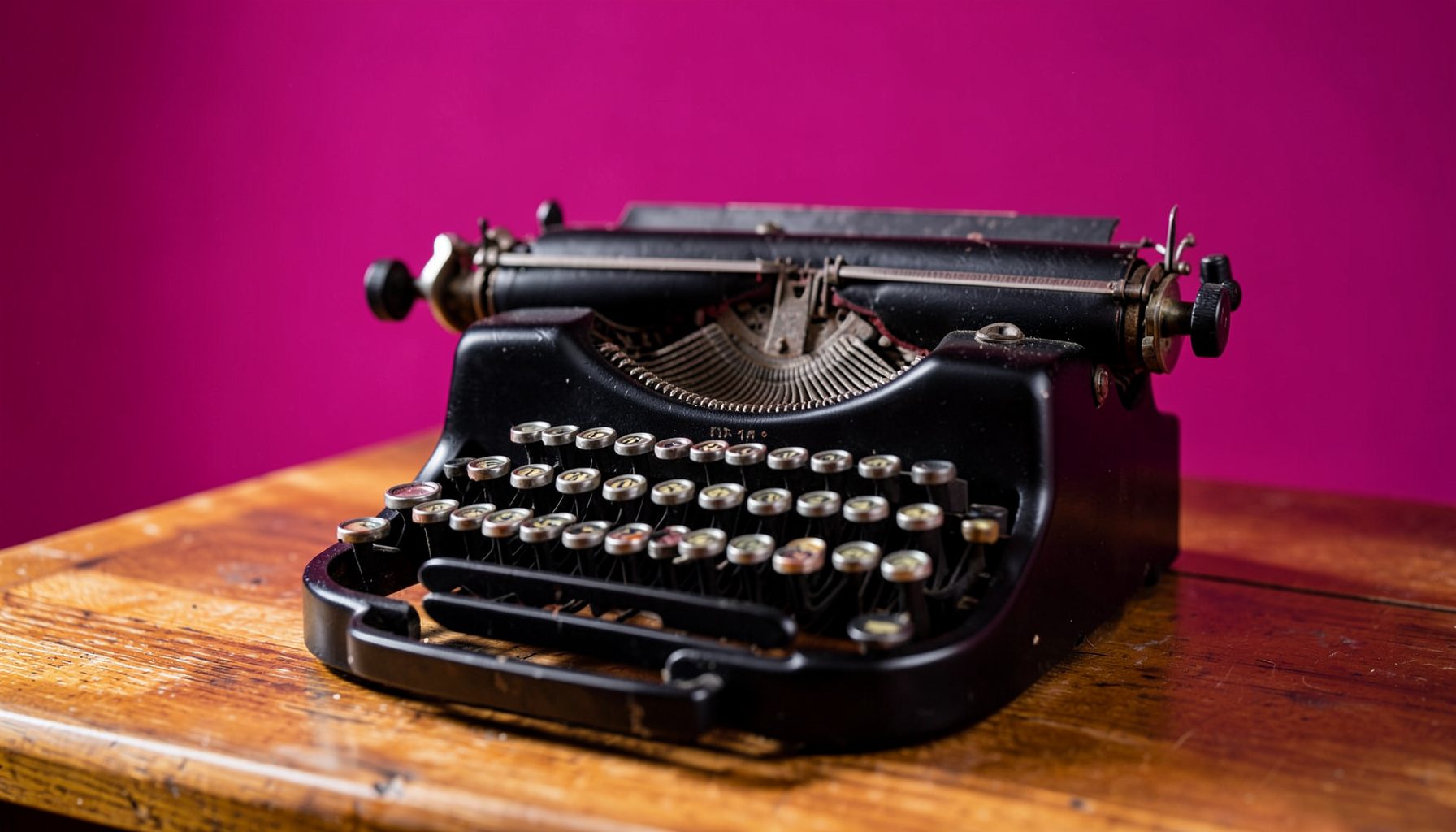
About the Collection
Typewriter House Collector is an informational archive dedicated to vintage and antique typewriters. The collection spans numerous international manufacturers, from well-known names like Adler, Corona, and Hermes to rare and obscure brands that shaped the history of mechanical writing.
Browse the alphabetical brand index to explore individual manufacturers and their models. Each entry documents a piece of typewriter heritage, reflecting the craftsmanship and industrial design of its era.
Typewriter Brands Index
An alphabetical directory of manufacturers represented in the archive. Select a brand to learn more.
- Adler
- American
- Anderson Shorthand
- Andina
- Automatic
- Bambino
- Bar-Let
- Bar-Lock
- Belka
- Bennett
- Bijou
- Bing
- Blickensderfer
- Blinden
- Blista
- Brooks
- Burroughs
- Caligraph
- Carmen
- Carissima
- Champion
- Chicago
- Columbia Bar-Lock
- Columbia Index
- Comercial Visible
- Continental
- Corona
- Correspondent
- Courier
- Crandall
- Crown
- Daugherty
- Dart
- Demountable
- Densmore
- Dial
- Diamant
- Discret
- Draper
- Edelman
- Edison Mimeograph
- Edland
- Ecole Pigier
- Elliot-Fischer
- Emerson
- Empire
- Erika
- Exact
- Fitch British
- Ford
- Fox
- Franklin
- Frister & Rossman
- Geniatus
- Graphic
- Granville Automatic
- Gritzner
- Groma
- Gundka
- Hall
- Hall Braille
- Hammond
- Hammonia
- Hartford
- Heady
- Helios
- Hermes
- Hogar
- Iberia
- Ideal
- Imperial
- Ingersoll
- International
- Jackson
- Januy Braille Writer
- Japy
- Jewett
- Junior
- Junior Toy
- Kanzler
- Karli
- Kappel
- Kee-Lox Electric
- Keaton
- Keystone
- Klein-Adler
- Lambert
- L.C. Smith
- Leframa
- Liliput
- Lord Baltimore
- Macy's
- Malling Hansen Skrivekugle
- Malling Hansen Replica Map
- Manhattan
- Matrix
- Mercedes
- Merrit
- Merz
- Mentor
- Meteor
- Mignon
- Molle
- Monica
- Monopol-Stolzenberg
- Monpti
- Morris
- Moya
- Visible
- Muson
- National 1889
- National
- Nema
- New America
Royal: cronología y modelos emblemáticos
Las máquinas de escribir de la marca Royal recorren una de las trayectorias más representativas del siglo XX, desde los pesados aparatos de oficina hasta las portátiles ligeras que cabían en un maletín. Su historia incluye cambios de ubicación,(factory) diversification and names, distintos sistemas de numeración y soluciones mecánicas cada vez más elaboradas. Por eso, cada ejemplar cuenta una pequeña historia del trabajo, el diseño y el consumo.
En Typewriter House Collector, esta evolución puede seguirse mediante fichas de modelos, referencias de números de serie y páginas sobre máquinas históricas. Royal resulta especialmente引用元 para el coleccionista porque reúne Poverty with pieces, and machines and an identity that changed: standard, portable, electric, Familiar with the market and later Royal McBee.
Orígenes de Royal y primeros modelos
Royal nació en Nueva York en 1906, impulsada por un grupo empresarial,领导 por R. H. Smith. La compañía se vinculó con la tradición de las máquinas de escritura visible iniciada por el Smith Premier. Su primer modelo característico fue el Royal Standard, una máquina de carruaje fijo, estructura robusta y mecanismo de cinta visible que facilitaba comprobar la posición de las letras.
Durante la década de 1910, la producción se amplió con máquinas de mayor tamaño y con las primeras versiones portátiles. Los Modelos 10 y 12 demostraron que la marca podía competir tanto en oficinas como en despachos pequeños. SuEvolución no estuvo limitada a una reducción de dimensiones: también incorporó mejores sistemas de carro, tabuladores y mecanismos para ajustar el interlineado.
En los años veinte aparecieron máquinas de oficina como la KMM, conocida por su resistencia y velocidad. Las-series KHM, KMM y otras variantes de cuerpo completo se convirtieron en compras frecuentes de empresas,不入ates and professional offices. Sus mecanismos, a menudo pesados, requerían mantenimiento regular, pero resistían un uso intensivo. Actualmente these models are valued both for their technical importance and for the state in which their original finish has been conserved.
El auge de las portátiles y el diseño Art Déco
El Modelo 10 fue una de las piezas decisivas de la expansión de Royal. Durante los años treinta se convirtió en un ejemplo reconocido de máquina portátil, con una carcasa capaz de proteger el mecanismo durante el transporte. Su riesgo was not absolute, but it showed that a useful typewriter no needed to remain permanently attached to a large desk. The “P” models emphasized this approach with particularly compact constructions.
En 1939 se presentó los Quiet De Luxe, una gama que promised more discreet operation than the heaviest office typewriters. Its rounded metal body, dark red keys and carefully controlled proportions made it one of the most attractive industrial designs of its time. The name “De Luxe” also conveyed an aspiration to comfort and prestige that went beyond the purely utilitarian nature of many contemporary office machines.
Para un coleccionista, la identificación de estas máquinas exige revisar la placa, el layout of the keyboard and the format of the serial. Una guía de Remington no permite descifrar directamente una placa Royal, pero muestra un método útil: fotografiar el número, contrastarlo con tablas y DOCUMENTAR sus características antes de atribuirle una fecha. Este cruce de evidencias reduce el riesgo de confundir una reparación, una placa trasladada o una serie tardía.
Guerra, posguerra y máquinas de resistencia
Durante la Segunda Guerra Mundial, Royal fabricó los Modelos 1942 y 1944,Estos known by collectors as “Phantom”. Su estructura metálica, el tamaño del carruaje y la selección de cinta los hicieron adecuados paraTemos oficiales, oficinas intensivas y environments where resistance took precedence over decorative appeal. Sus grandes carruajes permitían trabajar con formatosampaigns and documents extensos, aunque su peso y consumo de cinta los alejaban del uso doméstico.
En la posguerra, la marcawierly steered toward the modern office. Models such as the 104, 105 and 112 incorporated electric propulsion and sought to reduce the effort required for prolonged writing. They did not eliminate the mechanical principles inherited from earlier Royal machines; instead, they combined those principles with motors, revised carriage systems and more uniform factory production. The result was a more consistent family of office equipment.
La historia visual de este period puede complementarse con el blog USOM, útil como lectura secundaria para contrastar cambios en la construcción, el diseño y el uso cotidiano de las máquinas. Conviene tener presente que la guerra y la posguerra also brought changes in factories, materials and distribution. The same nominal model could present small mechanical differences according to production site, while accessories and finishes could change even more noticeably.
Herald, Safari y otros modèles个工作中的日常与机器细节
The postwar consumer market saw the arrival of the Royal Herald around 1950 and the Safari around 1954. The Herald featured a rounded profile and compact body that made it visually distinctive, with a design halfway between a portable and a small office machine. The Safari went further in its appeal to the domestic market through a molded plastic body, colored keys, ribbon cartridges and an integrated carrying case.
Both machines became familiar objects in homes, studies and small businesses. Their original colors, decals, cases and knobs are now important when evaluating condition, because replacement parts can reproduce the general appearance without reaching the same level of originality. Surface shine, yellowed plastic and worn key legends also help determine whether a machine spent years on a desk or remained carefully stored after its period of daily use.
The Royal Arrow represented the full-size office side of this transformation, with a metal body and a more imposing carriage. Comparing it with the Herald or Safari reveals how Royal addressed different customers without abandoning its established mechanisms. For a broader view of the environment that surrounded these objects, el archivo del Garden Club de Descanso puede aportar contexto sobre/Home and consumer culture, aunque no constitutes a specialized source on typewriters.
Variantes internacionales y criterios de identificación
Royal did not always manufacture every machine carrying its name in the same way. British and German production, together with later agreements and corporate changes, produced substantial differences in badges, mechanics, cases and serial formats. The 1965 merger with McBee led to the Royal McBee name, while later Royal-O-C models were manufactured by Smith Corona. These details make a purely visual classification unreliable.
The Royal Centurion and several portable ranges also demonstrate how the brand was presented in different markets. A collector should combine the nameplate with the keyboard layout, carriage dimensions, typebar arrangement and serial location. Cleaning can make a machine appear more uniform, so photographs taken before restoration and evidence of replaced parts have considerable documentary value. Originality must always be assessed together with mechanical condition.
The history of Voss offers a useful counterpoint to this more linear account of corporate expansion. The historia de Voss shows how smaller Scandinavian manufacturers developed distinctive machines despite the dominance of American brands. Comparing Voss with Royal clarifies that technical progress did not follow a single route: portability, silence, manufacturing cost and repairability often produced different answers depending on the local market.
Recomendaciones para evaluar una máquina Royal
A thorough examination should begin with identification and continue with mechanical, documentary and commercial assessment. The order prevents a attractive finish from distracting attention from a non-original plate, incompatible mechanism or incomplete set of accessories.
The final value should also be understood as the result of several combined factors rather than the age of the machine alone. A rare model in poor condition may be less desirable than a common model that works properly and retains most of its original components.
- Confirme la marca y el modelo mediante el emblema, el teclado, el carruaje y la placa de identificación; photographs are more reliable than memory.
- Localice y transcriba el número de serie without cleaning it beforehand, and contrast the format with documented examples and production dates.
- Pruebe el avance, el retorno del carro, el espacio, el tabulador and the escapement, checking for irregular movements or unusual noises.
- Check the original decals, keys, knobs, feet, case and accessories, since replacements can conceal important inconsistencies.
- Evaluate rust, dents, missing typebars, cracked plastic, platen wear and ribbon damage separately, and estimate the cost of any necessary restoration.
- Document provenance and compare recent auction results, dealer sales and completed transactions rather than relying only on asking prices.
Una Royal bien documentada allows its mechanical, aesthetic and historical values to be assessed together. That combined view is more reliable than either rarity alone or an attractive surface, and it provides the most solid foundation for understanding the machine as part of the history of writing.