A collector's reference cataloging historical typewriter brands and models from around the world.
About the Collection
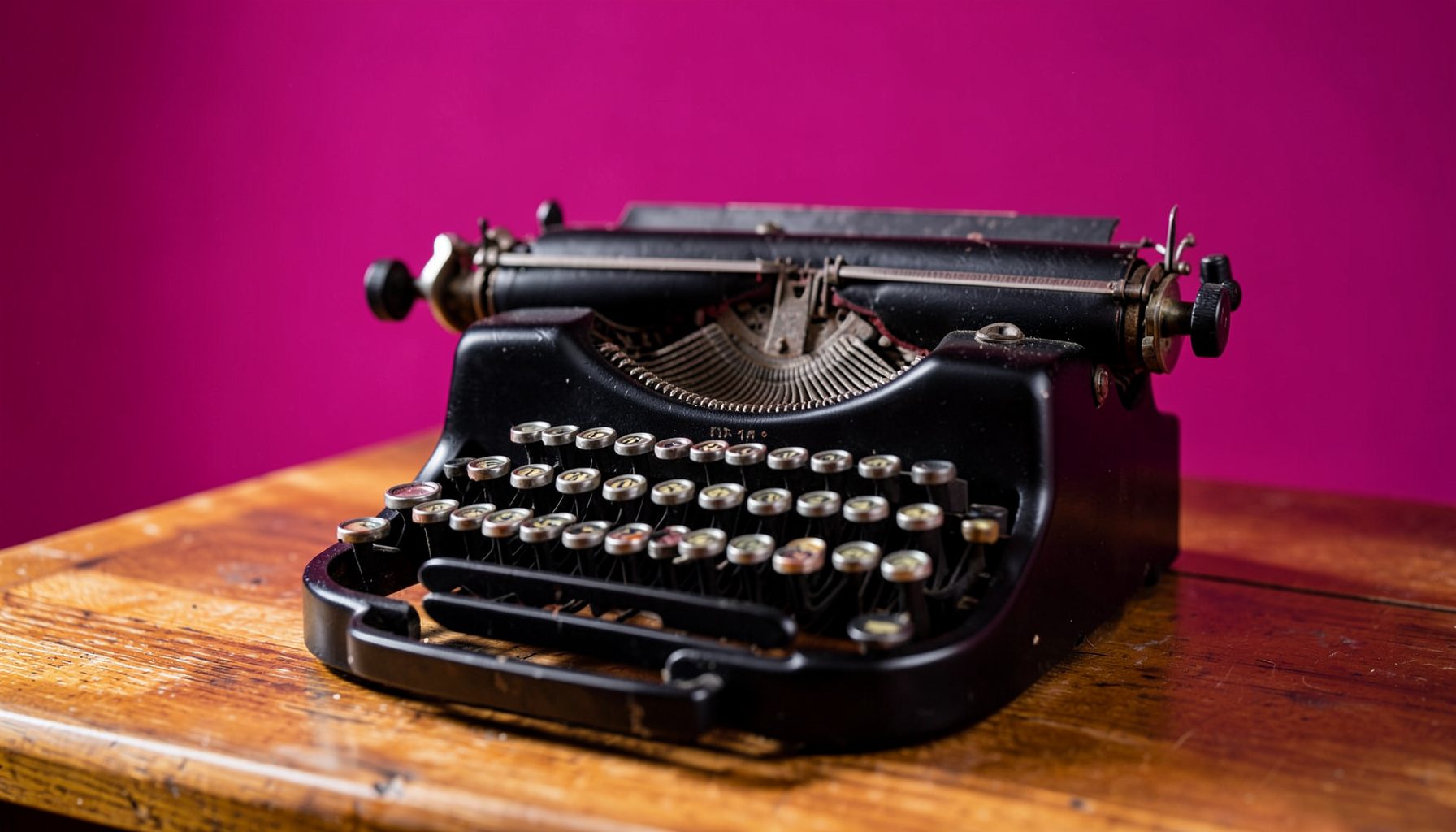
Typewriter House Collector is an informational archive dedicated to vintage and antique typewriters. The collection spans numerous international manufacturers, from well-known names like Adler, Corona, and Hermes to rare and obscure brands that shaped the history of mechanical writing.
Browse the alphabetical brand index to explore individual manufacturers and their models. Each entry documents a piece of typewriter heritage, reflecting the craftsmanship and industrial design of its era.
Typewriter Brands Index
An alphabetical directory of manufacturers represented in the archive. Select a brand to learn more.
- Adler
- American
- Anderson Shorthand
- Andina
- Automatic
- Bambino
- Bar-Let
- Bar-Lock
- Belka
- Bennett
- Bijou
- Bing
- Blickensderfer
- Blinden
- Blista
- Brooks
- Burroughs
- Caligraph
- Carmen
- Carissima
- Champion
- Chicago
- Columbia Bar-Lock
- Columbia Index
- Comercial Visible
- Continental
- Corona
- Correspondent
- Courier
- Crandall
- Crown
- Daugherty
- Dart
- Demountable
- Densmore
- Dial
- Diamant
- Discret
- Draper
- Edelman
- Edison Mimeograph
- Edland
- Ecole Pigier
- Elliot-Fischer
- Emerson
- Empire
- Erika
- Exact
- Fitch British
- Ford
- Fox
- Franklin
- Frister & Rossman
- Geniatus
- Graphic
- Granville Automatic
- Gritzner
- Groma
- Gundka
- Hall
- Hall Braille
- Hammond
- Hammonia
- Hartford
- Heady
- Helios
- Hermes
- Hogar
- Iberia
- Ideal
- Imperial
- Ingersoll
- International
- Jackson
- Januy Braille Writer
- Japy
- Jewett
- Junior
- Junior Toy
- Kanzler
- Karli
- Kappel
- Kee-Lox Electric
- Keaton
- Keystone
- Klein-Adler
- Lambert
- L.C. Smith
- Leframa
- Liliput
- Lord Baltimore
- Macy's
- Malling Hansen Skrivekugle
- Malling Hansen Replica Map
- Manhattan
- Matrix
- Mercedes
- Merrit
- Merz
- Mentor
- Meteor
- Mignon
- Molle
- Monica
- Monopol-Stolzenberg
- Monpti
- Morris
- Moya
- Visible
- Muson
- National 1889
- National
- Nema
- New America
Identificar máquinas de escribir españolas: Hispano Olivetti
La proliferación de máquinas de escribir en España durante la primera mitad del siglo XX estuvo acompañada de un mercado heterogéneo. Llegaron apparatus imported from Germany, France, Switzerland, the United States and Italy, while other companies made parts in Barcelona or assembled complete machines using foreign mechanisms. Marcas como Hispano Olivetti o Erika permitenUZan conexiones con la producción española, aunque el nombre comercial, el teclado en español o la apariencia del aparato no constituyen por sí solos pruebas suficientes.
Una identificación fiable exige combinar varias clases deevidence. El examinador debe distinguir entre fabricante, marca comercial, lugar de ensamblaje y distribuidor, registrar el modelo y el número de serie, revisar la placa identificativa y examinar la procedencia de sus componentes. Ese método resulta especialmente importante con Hispano Olivetti, una denominación asociada a la historia industrial de Barcelona que puede inducir a atribuir modelos sin comprobar su etapa de fabricación.
La marca no siempre demuestra la procedencia
En el mercado de la escritura mecánica, el nombre impreso en el frontal belonged frequently to la society or distributor, rather than necessarily to the factory that had manufactured the machine. An Olivetti sold in Spain could have been imported from Italy, while certain Hispano Olivetti machines were produced or assembled in Barcelona. Local distributors also added their own decals to imported stock, creating a visual mixture that can be misleading when the machine is examined years later.
Hispano Olivetti was a Spanish commercial and industrial name linked to Olivetti’s presence in Barcelona. Its use is therefore an important indication, but the exact version of the logo must be related to the model, serial sequence and factory documentation. The comparaciones visuales pueden ayudar a familiarizarse con esas variants before carrying out a detailed inspection.
The strongest attribution is based on the existence of a plate stating a Spanish manufacturer, together with a serial number consistent with that maker’s records. A keyboard with ñ, a Spanish manual or a decal placed by a retailer can corroborate the destination of the machine, yet none of those elements alone establishes where the complete apparatus was built.
La placa, el modelo y el número de serie
The first step consists of locating all the identifying marks without dismantling the machine. The model may appear on the front panel, on the paper table, on the ribbon-spool covers or on a small metal plate. The serial number is often placed beneath the carriage cover, at the rear of the frame or under a detachable cover. Older machines can also bear the address of the importer, the sales representative and the workshop that distributed them.
The transcription must be exact, including letters, hyphens, spacing and the order in which the characters appear. A later owner may have replaced the plate, or the serial may have been transferred from another machine during a repair. Any unusual element should be documented photographically, since its position can reveal whether it belongs to the original configuration or to a subsequent restoration.
The model designation and serial should then be compared with catalogs, manuals, auction descriptions and collector databases. A matching sequence can confirm a production period and sometimes a specific factory. When the information remains incomplete, the absence of a serial is less significant than a demonstrably incorrect one, since some small manufacturers used their own numbering systems and modified machines without updating every identifying component.
El teclado ofrece pistas del mercado español
The presence of the ñ key, the question marks and the inverted exclamation mark identifies a Spanish or Spanish-American preparation, but it does not necessarily indicate Spanish production. Imported machines were routinely supplied with a Spanish keyboard for the local market, and some importers changed only the keytops while retaining the original mechanism, carriage and accessories.
The arrangement of the keys can provide more specific clues. The space occupied by ñ, the placement of the accent key, the symbols beside the figures and the order of the letters should be compared with the corresponding Olivetti model. Differences in legends may reveal that the keyboard was later adapted, or that the machine belonged to a series prepared for a different distribution area.
Paper guides, instruction cards and ribbon packaging can also indicate the intended market. A Spanish-language service sheet is particularly useful when it carries a Spanish company’s address, although it may have been included with an imported unit. These elements are most valuable when combined with a serial number and manufacturing evidence rather than treated as conclusive on their own.
La etiqueta Hispano Olivetti y sus variantes
Hispano Olivetti machines are recognizable by the combination of the brand name, the model number and the decorative treatment of the frame. Depending on the period, the badge may present Hispano and Olivetti in different arrangements, while later examples use only the familiar Olivetti name with a Spanish plate. The lettering style, enamel finish and dimensions of the decal should be recorded before searching for a reference example.
The serial range is indispensable because logos and badges were reused over long periods. A machine bearing a certain number may correspond to an early production series, whereas an almost identical exterior can conceal changes in escapement, ribbon system or carriage construction. For that reason, photographs of the badge should always be accompanied by images of the full keyboard and the underside of the frame.
Decoration can provide an additional clue, though it must be interpreted carefully. The archive of modelos con incrustaciones collects examples featuring mother-of-pearl and metal inlays, allowing the identification of ornamental techniques and production variants. Such luxurious finishes were not exclusive to Spain, so they help distinguish a precise variant without replacing the verification of its origin.
La mecánica y los materiales revelan el origen
The mechanism offers physical evidence of the factory’s production methods. The shape of the typebars, the finish of the frame, the type of screws, the design of the ribbon reverser and the construction of the escapement can be compared with documented examples of the same model. These details may reveal a Spanish assembly line, an imported mechanism or a machine rebuilt with parts taken from another manufacturer.
Condition does not itself establish provenance. Poorly maintained machines often have replacement typebars, rewound springs, repainted panels and substituted keytops. In some cases, the original badge survives while the surrounding mechanism has been heavily modified. Conversely, a missing badge does not automatically disqualify Spanish production when the chassis, serial format and model construction point consistently in that direction.
The physical inspection should be respectful and non-destructive. Cleaning the mechanism without recording the original finish, polishing the plating or removing old decals can destroy useful evidence. If the attribution remains uncertain, the contacto del archivo de Typewriter House Collector ofrece una vía para consultar al responsable de la colección, Juan Ramon Gracia, y contrastar fotografías o datos de serie.
Contrastar archivos para fijar la atribución
A reliable investigation begins with a complete record: badge, model, serial number, keyboard layout, manufacturer’s plate and any evidence of local assembly. The recursos de Mike Patt pueden servir para contrastar variaciones de modelos, características técnicas y datos útiles para construir una chronology. The search should use exact spellings and include the alternative forms under which a model may have appeared in catalogs.
Once the references have been gathered, it is useful to establish three levels of certainty. A Spanish manufacturer’s plate with a consistent serial provides a strong attribution; a Spanish keyboard, decal or manual supports a Spanish-market origin; and an imported mechanism with no local manufacturing evidence requires a more cautious description. This hierarchy prevents a Spanish keyboard from being converted into an unsupported claim of national production.
An intermediate conclusion can be expressed accurately as manufactured in Spain, assembled in Spain or prepared for the Spanish market, depending on the evidence. Each formulation identifies a different degree of certainty. The final catalog entry should specify which physical or documentary elements support the wording, since a photograph of the badge alone rarely explains the complete history of the machine.
La identificación de una máquina de escribir española combina la lectura de marcas visibles con el conocimiento de la historia industrial del país. Hispano Olivetti ofrece una pista especialmente valiosa, pero su importance lies in the possibility of linking it with plates, serial ranges and mechanical variants. Cuando these elements converge, the attribution acquires a documentary foundation that remains useful even after the machine has passed through several owners or undergone a partial restoration.