A collector's reference cataloging historical typewriter brands and models from around the world.
About the Collection
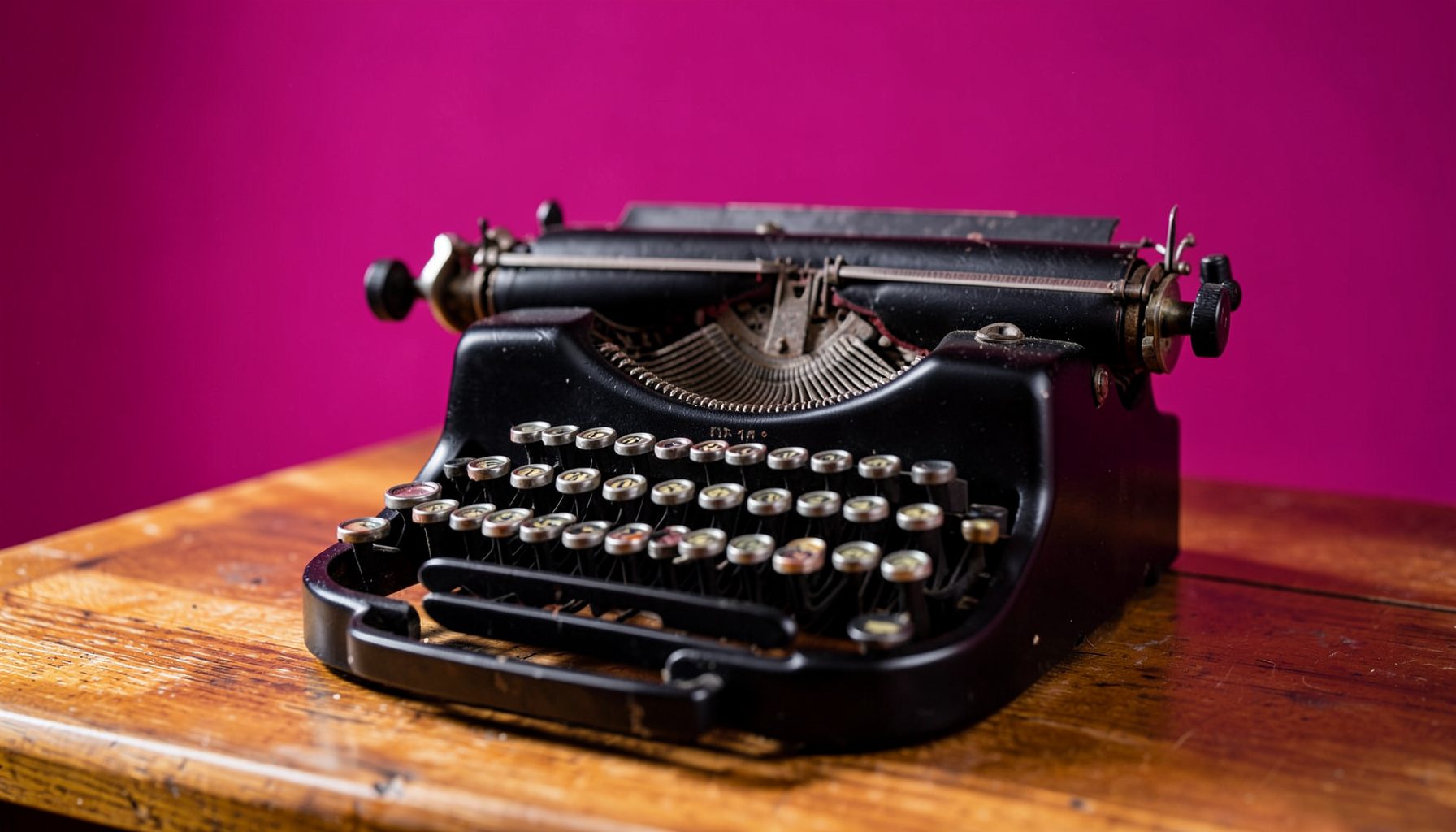
Typewriter House Collector is an informational archive dedicated to vintage and antique typewriters. The collection spans numerous international manufacturers, from well-known names like Adler, Corona, and Hermes to rare and obscure brands that shaped the history of mechanical writing.
Browse the alphabetical brand index to explore individual manufacturers and their models. Each entry documents a piece of typewriter heritage, reflecting the craftsmanship and industrial design of its era.
Typewriter Brands Index
An alphabetical directory of manufacturers represented in the archive. Select a brand to learn more.
- Adler
- American
- Anderson Shorthand
- Andina
- Automatic
- Bambino
- Bar-Let
- Bar-Lock
- Belka
- Bennett
- Bijou
- Bing
- Blickensderfer
- Blinden
- Blista
- Brooks
- Burroughs
- Caligraph
- Carmen
- Carissima
- Champion
- Chicago
- Columbia Bar-Lock
- Columbia Index
- Comercial Visible
- Continental
- Corona
- Correspondent
- Courier
- Crandall
- Crown
- Daugherty
- Dart
- Demountable
- Densmore
- Dial
- Diamant
- Discret
- Draper
- Edelman
- Edison Mimeograph
- Edland
- Ecole Pigier
- Elliot-Fischer
- Emerson
- Empire
- Erika
- Exact
- Fitch British
- Ford
- Fox
- Franklin
- Frister & Rossman
- Geniatus
- Graphic
- Granville Automatic
- Gritzner
- Groma
- Gundka
- Hall
- Hall Braille
- Hammond
- Hammonia
- Hartford
- Heady
- Helios
- Hermes
- Hogar
- Iberia
- Ideal
- Imperial
- Ingersoll
- International
- Jackson
- Januy Braille Writer
- Japy
- Jewett
- Junior
- Junior Toy
- Kanzler
- Karli
- Kappel
- Kee-Lox Electric
- Keaton
- Keystone
- Klein-Adler
- Lambert
- L.C. Smith
- Leframa
- Liliput
- Lord Baltimore
- Macy's
- Malling Hansen Skrivekugle
- Malling Hansen Replica Map
- Manhattan
- Matrix
- Mercedes
- Merrit
- Merz
- Mentor
- Meteor
- Mignon
- Molle
- Monica
- Monopol-Stolzenberg
- Monpti
- Morris
- Moya
- Visible
- Muson
- National 1889
- National
- Nema
- New America
Máquinas de escribir Sears: catálogos y modelos distribuidores
La historia de las máquinas de escribir de la marca Sears está entrelazada con la actividad de Sears, Roebuck & Co. como vendedor por catálogo y distribuidor. La compañía adaptaba máquinas de distintos fabricantes a su red comercial, pero también comercializó equipos con emblema propio. Por ello, la palabra Sears puede designar una marca minorista, un origen industrial o una etapa de distribución, y no una genealogía técnica única.
Los catálogos generales y los impresos de temporada fueron el principal escaparate de esa oferta. En sus páginas, una máquina podía aparecer bajo el nombre de otra marca, como Sears, con un número seguido de cambios de acabado, teclado, cinta o estuche. El anuncio reflejaba lo que Sears quería vender en ese momento, no necesariamente una actualización inmediata de cada modelo ni una descripción técnica completa.
Estudiarlas exige leer la publicidad con el mismo cuidado que se inspecciona la máquina. El nombre del catálogo, el precio, la garantía, la numeración y las fotografías deben contrastarse con los números de serie, las placas del fabricante y los detalles mecánicos. Este cruce convierte un anuncio comercial en evidencia histórica y ayuda a distinguir una producción original de una modificación posterior.
Sears como vendedor y distribuidor
Conviene separar fabricante, marca comercial y vendedor. Sears funcionó durante mucho tiempo como comprador y canal de venta: una máquina podía haber sido construida por Underwood, Smith-Corona, Royal o Remington y llevar el nombre de Sears, o conservar las insignias de su productor. Estas situaciones responden a acuerdos distintos y no deben fundirse únicamente porque el mueble, las teclas o la maleta sean semejantes.
En distintos periodos se ofrecieron máquinas de varias procedencias, unas con su marca original y otras con calcomanías de Sears. La denominación「Sears」no identificaba por sí sola una serie homogénea: una portátil de cuatro filas y otra de sobremesa podían compartir ese distintivo y tener mecanismos, fechas y series de numeración sin relación directa. Los catálogos y las piezas conservadas permiten comprobar cómo se aplicaba la marca en cada campaña.
La distribución también influía en la disponibilidad. Una Determinación anunciada en un catálogo_print could be ordered directly by mail and received through Sears stores or an authorized route. This made the label a guarantee of commercial support, but not necessarily of exclusive distribution. The same machine could be found in independent shops, with the dealer decal or identifying inscriptions varying by place and year.
Los catálogos y su lectura comercial
Los advertisements of typewriters usually gathered several data: number of keys, keyboard arrangement, width of carriage, shifting system, ribbon or spool mechanism, typebar striking, included case, guarantee and price. Descriptions such as “portátil”, “de sobremesa”, “autOMÁTICA” o “con cambio de cinta” reveal sales language more than a precise technical classification. A small change in color or included accessories might also cause Sears to publish a different model reference.
Each catalogue constituted a snapshot. Its reference number identifies a particular issue, but the product may have appeared in several supplements, reprints or seasonal campaigns. Nor does a successful advertisement demonstrate that the machine was newly manufactured that year. Old stock, factory clearance and gradual replacement of mechanisms could keep the same commercial name in circulation for longer than its original production run.
Price is particularly useful for establishing relative position. A visible office machine, a folding portable and an electric model occupied different market segments. Sears could also change the guarantee, delivery terms or included accessories without replacing the basic mechanism. Consequently, a higher catalog price should not automatically be interpreted as a more advanced manufacturing date.
Modelos de marca Sears y productos de otros fabricantes
Un modelo distribuidor era, en la práctica, una configuración offered under Sears’ commercial system. The printed illustration might show a standard keyboard, a narrow carriage, a different ribbon mechanism or a simpler carrying case. These references were not always based on the engineering nomenclature used by the factory. A collector who searches only for a model series on the maker’s list can therefore overlook machines sold successfully under the Sears name.
Some pieces carried a small Sears decal applied to a mechanism originally marketed by another company. Other machines were designed for Sears from the outset, while others continued to show their producer’s name and were merely included in the company’s catalog. Paint can conceal the origin of a badge, and restoration can add one that never existed. The inscription itself should be treated as one piece of evidence, alongside the frame and mechanical layout.
The terminology also changed over time. Sears moved from visible typewriters to folding portables, office machines and, later, electric models while retaining broad commercial descriptions. A number printed beside a name may have referred to the finish, the package or the order code more than to a major technical redesign. Comparing consecutive catalogs is usually more revealing than assigning a production year from the word “Sears” alone.
Identificación del fabricante y del modelo
The identification process begins with documentation. It is useful to photograph the front of the carriage, the paper table, the keyboard, the underside and every badge before cleaning or repairing anything. On many machines the serial number appears on the carriage, frame or mechanism. Castings, screws, shifting components and ribbon-spool arrangement can also distinguish two superficially similar products distributed under the same label.
Mechanical comparison is especially useful when the original plate has been lost. The architecture of the escapement, the shape of the typebars, the location of the ribbon selector or the carriage-return mechanism can reveal the manufacturing family more reliably than a decorative emblem. Technical notes and documented interventions from historias de reparación offer a useful reference for examining these details without dismantling parts unnecessarily.
Sears badges and plates should be preserved, but not treated as infallible. They can be original factory decals, later retailer additions or replacements made during a previous restoration. Similarly, a machine may have received new knobs, ribbon covers or feet while preserving its mechanism. A reliable description separates original components from replacements and explains how confidently the maker can be attributed.
Números de serie y datación
Los números de serie dependen del fabricante, no de la tienda que vendió la máquina. Underwood employed numerical series, Smith-Corona used letters and numbers, and Royal relied on letter-based groups, although each producer modified its system over time. For example, the initial “A” used by Smith-Corona covered several related families, so it cannot by itself establish an exact year. Tables prepared for one maker should never be applied to another without checking the format.
For a machine carrying a Sears name, the serial number may still belong to the underlying producer. This is particularly evident when the mechanism was built for sale through the retailer’s catalog and only the identifying decal differed. To contrast a Royal base, the cronología de máquinas Royal provides a useful sequence of families and references against which the frame, mechanism and serial number can be checked.
A defensible dating range should combine several sources: the catalog in which the configuration appears, the serial series, the physical characteristics and any dated evidence attached to the machine. The range should remain approximate unless one element provides an exact production date. A catalog price alone cannot close that gap because Sears reused familiar names and promotional descriptions for long periods.
Precios, garantías y red comercial
Los importes publicados permiten situar una máquina within the catalog’s commercial hierarchy, but they do not determine its present collector value. Condition, completeness, originality and the demand for a particular mechanism can separate two similar machines by a considerable margin. A dismantled portable missing its case or paper table should not be valued as though it retained the complete package advertised in the original pages.
The guarantee text is often as important as the price. Sears advertised exchanges, repairs and trial periods with wording that changed between campaigns. Those conditions reveal how the company wanted customers to perceive risk, yet they do not prove that every machine was repaired by Sears personnel. Local offices, independent workshops and transport arrangements could all influence the practical after-sales experience.
For a documented specimen, it is useful to send photographs of the badges, serial number and keyboard to the contacto del coleccionista. A precise question about a visible mechanism can prevent a generic attribution from becoming an unsupported claim. Nevertheless, the strongest response combines expert opinion with the collector’s own photographs, catalog references and maintenance history.
Documentación, conservación y referencias
Una ficha sólida conserva la mayor cantidad posible de evidencia original. Los catálogos debe criticarse con susOffer dates and campaign, no isolated from the machine to which they refer. The following practices help maintain a coherent record:
- Fotografiar el número de serie, las calcomanías, el carro y la parte inferior antes de cualquier intervención.
- Transcribir literalmente el nombre, el número y el precio del modelo anunciado en el catálogo.
- Conservar las piezas desmontadas junto con notas sobre su posición y su estado.
- Comparar la numeración y el mecanismo con las referencias del fabricante real.
- Separar los componentes de fábrica de las calcomanías, repuestos o reparaciones añadidos.
- Anotar la procedencia, las fechas comprobables y cualquier duda que permanezca abierta.
El valor documental suele crecer cuando la investigación reúne advertising, physical machine and archival references in the same record. A catalog image identifies what Sears offered; the serial number connects the object to a manufacturing sequence; and the physical details confirm which information belongs together. This combination produces a more accurate history and protects the machine from being reduced to a name and a date without supporting evidence.